
Commons Construct
Overview
Commons Constructs are the shared structural objects inside Commons Architecture that stabilize meaning, organize missions, map relationships, and prepare content for execution and delivery. They are the structural backbone of the Initiative’s worldview. There are two distinct types – Universal and Conceptual
Construct Types
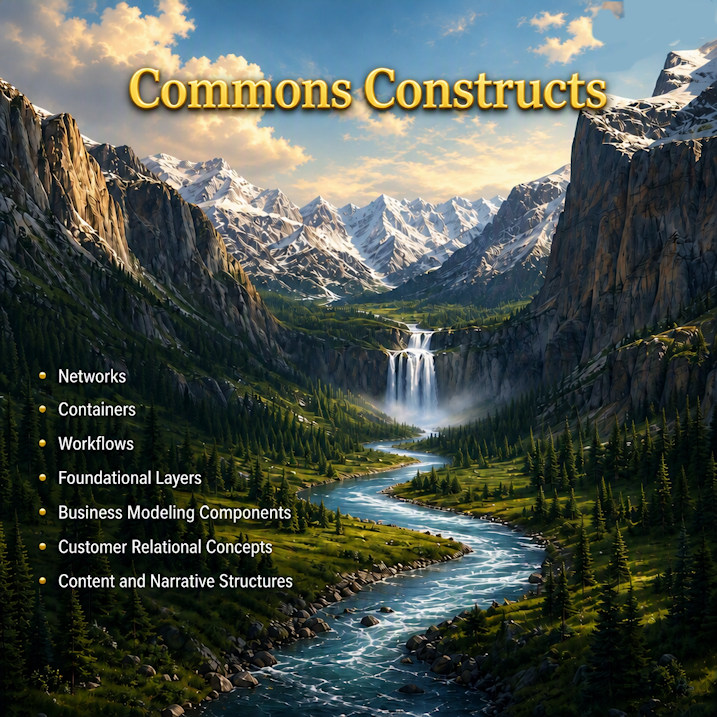
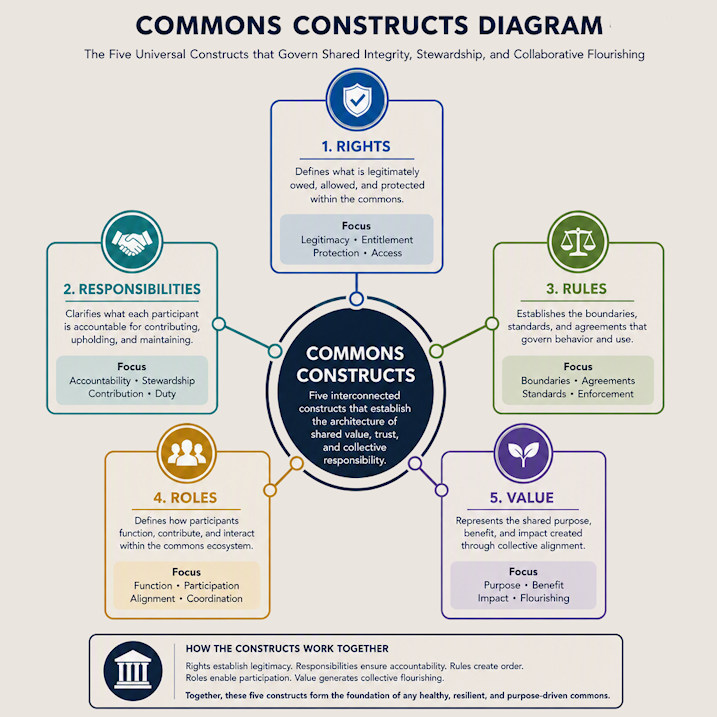
Commons Constructs exist in two governing families that together define the full architecture of the Commons. The first are the Universal Constructs — Rights, Responsibilities, Rules, Roles, and Values — which establish the moral and relational foundation of shared integrity, stewardship, and collaborative flourishing. They describe how people and systems behave within the Commons, forming its ethical and trust‑based core. The second are the Conceptual Constructs, which include Commons Networks, Commons Containers, Commons Business Modeling Components, Commons Relational Concepts, Commons Workflows, Commons Content and Narrative Structures, and Commons Foundational Layers. These define how meaning, movement, and relationships are organized, translating belief and purpose into coherent architectural form. Together, the Universal and Conceptual Constructs create a complete system: the Universal set governs why the Commons exists and how integrity is maintained, while the Conceptual set governs how the Commons is structured, interpreted, and experienced — uniting belief, architecture, and relational coherence under one governing vision.
Universal Constructs
Universal Constructs form the Commons’ integrity backbone — the shared moral and relational framework that governs how people and systems behave within the environment. Through Rights, Responsibilities, Rules, Roles, and Values, they establish the conditions for trust, stewardship, and collaborative flourishing. These constructs apply everywhere in the Commons, providing a stable, universal foundation that ensures every interaction, offering, and relational movement is grounded in shared integrity.
Construct Types
- Rights
- Responsibilities
- Rules
- Roles
- Values
Conceptual Constructs
Conceptual Constructs form the Commons’ architectural framework — the structures that organize meaning, movement, and relational flow across the environment. Through Commons Networks, Commons Containers, Commons Business Modeling Components, Commons Relational Concepts, Commons Workflows, Commons Content & Narrative Structures, and Commons Foundational Layers, they translate belief and purpose into coherent architectural form. These constructs define how the Commons is structured, interpreted, and experienced, giving it clarity, navigability, and unified relational logic.
Commons Network
Commons Networks are the Initiative’s shared relational pathways — the way people, organizations, sponsored endeavors, and missions move and connect inside the Commons. Instead of traditional navigation or product menus, Commons Networks express relationships, identity, and mission movement. They show how different parts of the Initiative relate to one another, how meaning flows, and how users travel through shared spaces in a belief‑aligned way. Commons Networks turn the digital environment into a relational map rather than a set of modules, ensuring every interaction reflects the Initiative’s worldview and governing vision.
Commons Networks reveal the relationships that guide movement — how meaning flows, how people find their way, and how shared purpose links different parts of the environment. They form naturally through Guiding Navigation, Clear Paths, Signposts, Landmarks, and Connections, creating a relational map that helps people explore, engage, and contribute in meaningful ways. Commons Networks make the Commons feel alive, connected, and easy to move through — a place where relationships shape the experience.
Commons Containers
Commons Containers are the meaningful “places” within the Commons that hold identity, purpose, and shared understanding. They give shape to experiences, stories, relationships, and movement so people can engage them clearly and confidently. Each container provides a stable space where something important can be recognized, interacted with, and carried forward. Through Commons Containers, people understand what a space is for, how it relates to them, and how it connects to the wider Commons. They make the environment feel coherent, trustworthy, and easy to navigate by giving form to identity, context, mission, and belonging.
- Identity Containers — are the places within the Commons that hold and express who we are — individually, collectively, and in relationship with the Lord. They give shape to identity so people can recognize themselves, understand their place, and see how they fit within the wider Commons. Identity Containers stabilize the core elements of belonging: personal identity, shared identity, mission identity, and relational identity. They help people engage confidently by providing a clear sense of “this is who I am,” “this is who we are,” and “this is how we relate.”
- Narrative Containers — hold stories, meaning, and shared understanding and are the places within the Commons that hold the stories, meaning, and shared understanding that help people make sense of where they are and why it matters. They give structure to the narratives that shape identity, purpose, and movement — allowing people to see how their own story connects to the larger story of the Commons. Narrative Containers make meaning feel clear, accessible, and grounded by providing spaces where stories can be gathered, interpreted, and carried forward.
- Mission Containers — hold purpose, direction, and movement and are the places within the Commons that hold purpose, direction, and movement. They give structure to the missions people carry — helping individuals and communities understand what they are called to do, how that purpose fits within the wider Commons, and how their movement contributes to shared Kingdom alignment. Mission Containers make purpose feel clear, actionable, and connected by providing stable spaces where mission identity, mission stories, and mission progression can be recognized and engaged.
- Context Containers — hold clarity, framing, and orientation and are are the places within the Commons that hold clarity, framing, and orientation. They help people understand where they are, what something means, and how it fits within the wider Commons. By stabilizing context, these containers make experiences feel coherent, trustworthy, and easy to interpret. They ensure that meaning is not left to guesswork — people can see the purpose of a space, the story behind it, and the direction it supports.
Commons Workflows
Commons Workflows are the movement patterns inside the Commons — the ways people, stories, missions, and relationships flow from one meaningful place to another. They show how engagement unfolds, how purpose progresses, and how shared meaning travels through the environment. Instead of technical processes or task sequences, Commons Workflows express relational movement: how people gather, learn, contribute, and belong; how stories deepen; how missions advance; and how identity grows. They make the Commons feel alive and connected by revealing the natural pathways of movement that shape experience. While they can have relationship to the internal VIA based workflow systems, they are not part of RAPTA or RICAD.
- Relational Movement — how people move through relationships and shared spaces
- Mission Movement — how purpose progresses and direction becomes action
- Narrative Movement — how stories develop, deepen, and connect
- Identity Movement — how people grow, align, and find their place
Commons Business Modeling Components
Commons Business Modeling is the way the Commons turns purpose, mission, and relational meaning into clear, usable structures. Instead of traditional business models or commercial frameworks, Commons Business Modeling expresses how purpose becomes form, how identity becomes structure, and how shared meaning becomes something people can actually engage with. It translates the Initiative’s vision into stable components that help people understand offerings, relationships, movement, and value inside the Commons.
It ensures that everything in the Commons — experiences, missions, relationships, and shared spaces — is shaped by the same Source, the same worldview, and the same relational logic.
- Value Components — how value is expressed in relational, mission‑aligned ways
- Relational Components — how people, places, and purpose connect
- Offering Components — how offerings are structured as shared purpose, not products
- Directional Components — how guidance, movement, and alignment are expressed
- Structural Components — how meaning is stabilized so it can be engaged
Commons Business Modeling makes the Commons work — not as a marketplace or a platform, but as a shared environment where purpose, identity, and mission can be understood, engaged, and carried forward. It ensures that everything people encounter is coherent, relational, and aligned with the Initiative’s governing vision. It is the bridge between meaning and structure, turning belief‑aligned purpose into something people can actually navigate, experience, and contribute to.
Commons Relational Concepts
Commons Customer Relational Concepts redefine how relationships are understood and formed within the Commons. Instead of treating people as customers or users, the Commons sees them as participants in shared meaning, contributors to purpose, and holders of relational value. These concepts shift engagement from transactional to relational — grounded in belief, identity, trust, and shared movement. They help people feel known, connected, and part of something meaningful, while giving the Initiative a clear way to understand and nurture those relationships.
Commons Customer Relational Concepts reshape how the Initiative relates to people by focusing on belief‑oriented connection, shared purpose, and mutual flourishing.
- Relational Identity — who a person is in relationship to the Commons and the Lord
- Relational Value — the meaning a person brings through presence, purpose, and contribution
- Relational Movement — how people grow, engage, and progress through shared spaces
- Relational Trust — the safety, reliability, and confidence that sustain long‑term connection
- Relational Reciprocity — the give‑and‑receive dynamic that strengthens belonging and shared purpose
Commons Customer Relational Concepts ensure that every interaction is shaped by relationship, not transaction. They help the Initiative understand people through identity, purpose, movement, and trust, creating a relational ecosystem where people flourish together. This becomes the foundation for Commons Business Modeling, Commons Workflows, and Commons Networks, ensuring that everything is aligned with the same Source and the same relational vision.
Commons Content & Narrative Structures
Commons Content & Narratives are the structured stories that communicate the meaning, identity, and purpose of the Commons. They translate the deeper architecture of the Commons into clear, accessible content that people can understand, engage, and carry forward. Rather than being marketing copy or informational text, Content Narratives are meaning‑bearing stories — they show why something matters, how it connects, and what it invites people into. They ensure that every piece of content reflects the same Source, the same vision, and the same relational logic.
- Identity Narratives — who we are and how identity is expressed
- Mission Narratives — what we are called to do and how purpose moves
- Context Narratives — how meaning is framed and understood
- Experience Narratives — how people gather, learn, participate, and belong
- Relational Narratives — how relationships form, deepen, and sustain movement
They ensure that every communication — whether a story, description, offering, or explanation — is aligned with the Commons architecture. Content Narratives help people see the Commons as a unified environment, not a collection of parts. They make meaning portable, relational, and consistent, allowing people to understand the Commons wherever they enter and however they engage.
Commons Foundational Layers
Commons Foundational Layers are the deep structures that give the Commons its clarity, coherence, and meaning. They provide the underlying framework that helps people understand why the Commons exists, how it is shaped, and how everything connects back to the same Source. These layers anchor the Commons in shared belief, shared vision, and shared purpose, ensuring that every experience, interpretation, and interaction is built on a stable and unified foundation. They make the Commons feel trustworthy, consistent, and aligned — no matter where someone enters or how they engage.
- Shared Ground — the unified Source that everything stands on
- Structural Clarity — the framework that organizes meaning and movement
- Directional Logic — the flow that guides how the Commons forms and grows
- Interpretive Stability — the consistency that keeps meaning anchored
- Regenerative Flow — the cycle that allows insight, experience, and mission to return and strengthen the whole
- Belief Oriented Foundation – Integrating The Word into design means we add