
Vision Interpretive Center
Overview
Vision Interpretive
Vision is given and then formed. The process moves from revelation, to initiative, to creativity, to alignment, and finally to direction. Along the way, the person seeks, finds, believes, speaks, and imparts. At the end of this process, the vision is a seed: clear enough to be planted and ready to grow. Vision Interpretive serves in two ways. It forms the seed from what has been given, and it advises organizations as that vision is interpreted and carried into their work.
Businesses have ministries, and ministries have businesses
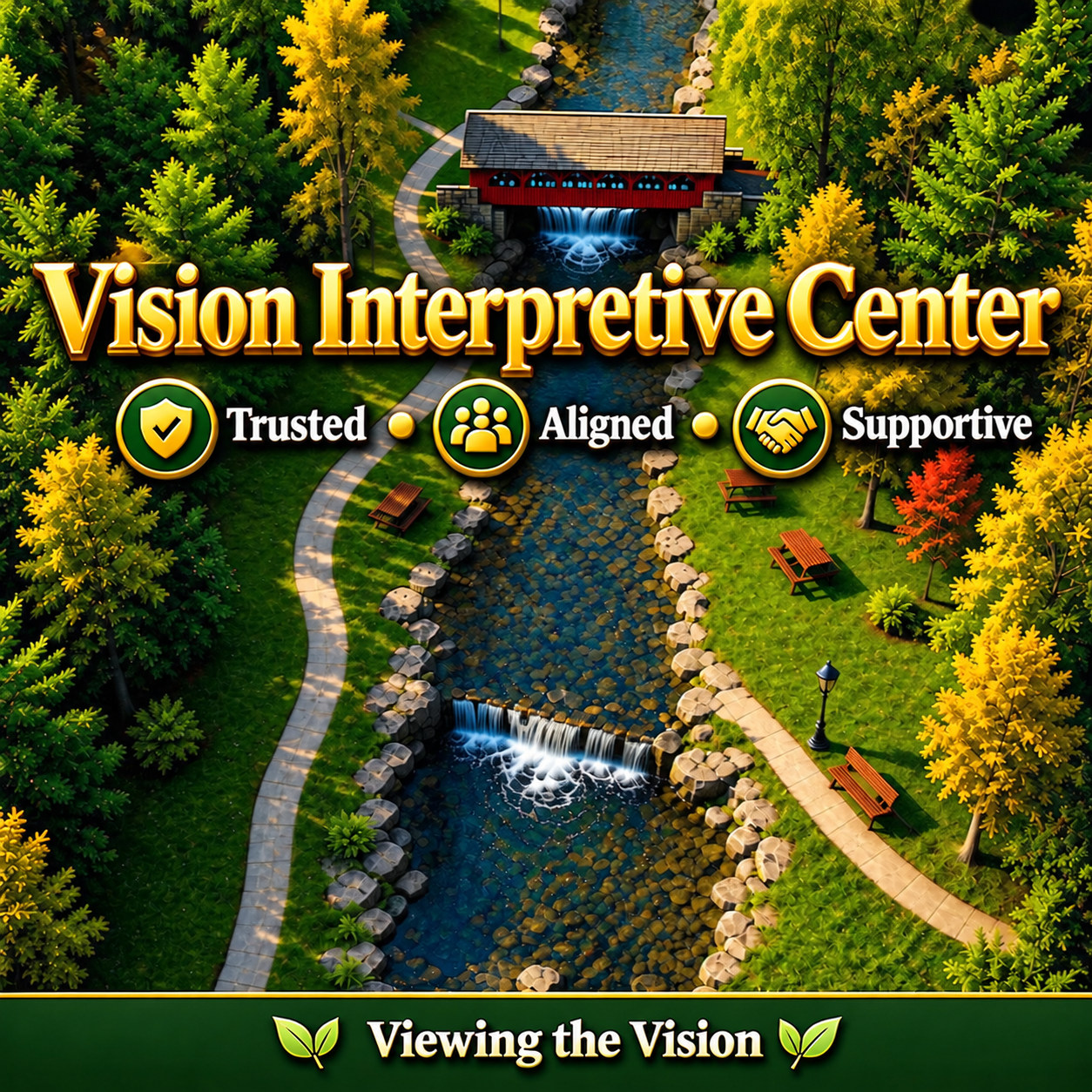
The Vision Interpretive Center (VIC) is the public gateway to the whole endeavor. It follows a simple cycle. Vision is the seed: the learning process of Continual Learning, taught by Instructors. Interpretive is the time to plant, nurture, and reap. After learning comes the need for implementation, carried out through a process called Advisory Formation and guided by Advisors. Harvest is the result, which leaves seed for the next season. We are at the beginning, at the seed stage, and VIC is where you start: Viewing the Vision.
Vision
Typical secular thought limitations affirm that every vision starts as a seed: a revelation, an inspiration, an insight that something could be different. However, if we accept that a vision to us is an acceptance from external revelation given to us, vision initiated is not a true seed, until it formed. So this process is what we will learn about.
Vision is the seed. Interpretation is the time. Harvest is the result.
Viewing the Vision introduces Vision as the seed that sets Continual Learning in motion. Training begins with a request. An individual can request training for themselves. An organization can request focused training courses built around their personnel. Once a request is accepted, the learners become students, and a Continual Learning process is created for them through five steps known as RICAD: Revelation, Initiative, Creativity, Alignment, and Direction. In plainer terms: seek, find, believe, speak, impart. Seek revelation. Find the initiative. Believe, and so create. Align with what is spoken. Impart the vision to direction. From there, the seed is carried through Initiative to a Harvest, so you can see where we stand today and how your own work connects to it.
Interpretive
The Interpretive stage is where learning becomes implementation. When the Continual Learning of Vision is complete, the student begins a journey and becomes a partner. This is the time to plant, nurture, and reap. Where Vision gives direction through Instructors and the five steps of RICAD, Interpretive gives advisory through Advisors and Advisory Formation, which moves along the journey in five steps known as RAPTA: Research, Analysis, Presentation, Technical, and Architecture. In plainer terms: discovery, discernment, display, definition, design. Along the way, Advisors work alongside their partners to carry the vision into daily operations, build the projects and programs they need, and sharpen their own ability to perform their tasks. This is where the need for consultancy opens. One thought runs through it all: businesses have ministries, and ministries have businesses.
Harvest
When the seed has been planted, nurtured, and reaped, harvest is what we hold: the fruit of implementation, in people and in organizations. It arrives in its season, not before. But harvest is not only the result. It is the beginning of growth, the next step. It never leaves the field empty, because part of it is kept as seed. What was learned, what was seen more clearly, and what was newly given all become the start of the next season. This is how growth happens: not by finishing, but by being better prepared to begin again.
Hierarchical Layers
When vision guides interpretive capabilities and interpretive capabilities guide action, individuals and organizations move forward with confidence, consistency, and long-term impact. Reactive decision-making becomes intentional, vision-aligned progress.
- Vision Interpretive Center: the entry point, covering orientation, portfolios, and goals.
- Vision Interpretive Structure: this is the first destination from the VIC, presenting There and Back’s portfolios.
- Vision-Based Direction: the second destination from the VIC, where foundation and purpose are illustrated.
- Vision Interpretive Leadership (VIL). Leadership that serves the vision, guiding people toward shared purpose through transformational and servant practice.
- Vision Interpretive Organization (VIO). Organization in which shared vision and interpretation let people see where they fit and how their work connects to the whole.
- VVision Interpretive Technology (VIT). Technology that supports interpretation and understanding, keeping every part of the system expressing the same vision.
Vision Interpretive Center (VIC) Introduction
The Vision Interpretive Center (VIC) is the center of There and Back’s online presence. It provides the first point of clarity for members, explaining how the online presence is organized, how its portfolios relate to one another, and how individuals can understand and navigate the broader system. Members are the customers of its market efforts, students, instructors, partners, and advisors. The VIC establishes the shared understanding that allows each portfolio to operate with purpose, coherence, and alignment.
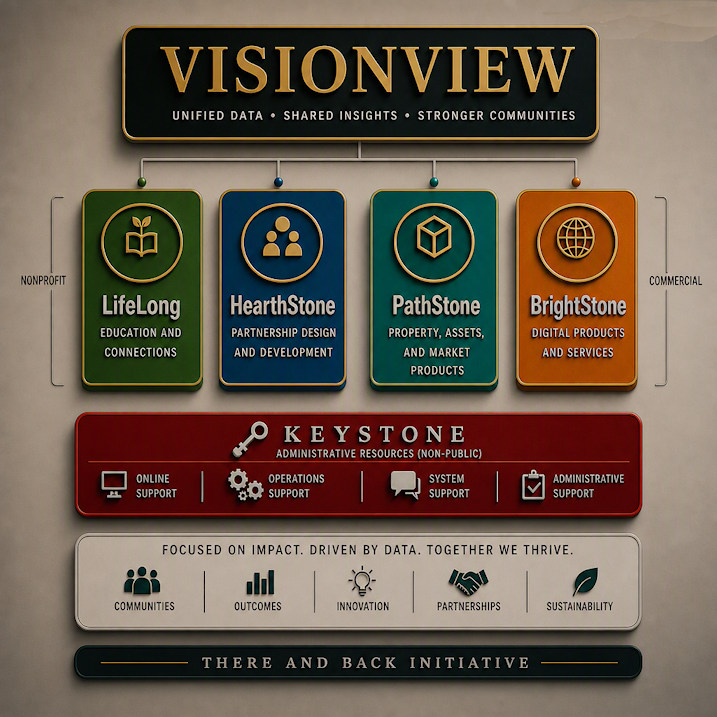
The VIC introduces these portfolios: BrightStone for digital products, PathStone for market products and properties, LifeLong for Continual Learning, HearthStone for Advisory Formation, and KeyStone for system application and support. It also introduces VisionView, the user experience through which members engage with them. It clarifies the purpose of each portfolio, the boundaries that keep them distinct, and the shared principles that unify them.
The VIC does not execute workflows or govern operations. Those functions remain within their respective engines and support systems. Instead, the VIC defines meaning, direction, and alignment. It is the guide, not the engine; the center, not the domain; the orientation, not the execution. Through this role, the VIC ensures that every portfolio contributes to a coherent, member-focused experience and that Vision Interpretive can scale with clarity and integrity.
VIC Goals
- Sets Direction — Defines the overarching vision so every portfolio moves with clarity and purpose.
- Maintains Alignment — Keeps each portfolio and its offerings oriented to the same governing vision, through shared understanding rather than operational control.
- Provides the Elevated View — Shows members how individual portfolios connect within the larger Vision Interpretive structure.
- Guides Interpretation — Supplies the shared patterns of meaning, identity, and movement that help members understand and navigate the system.
- Orients Members, Gives members a first point of clarity so they can find their place and move confidently among portfolios.
Vision Interpretive Structure
Vision Interpretive Portfolios
Lead me to There and Back’s Offerings
Vision Interpretive Structure is the organizing framework which offers the high-level view of the four core portfolios that shape the work of There and Back. Each portfolio expresses a distinct dimension of the whole, yet all are unified through a single approach that keeps the work trusted, aligned, and supportive. Together they form a coherent system that helps members understand how There and Back functions and how their own work connects within it.
Note: Keystone is a supporting platform for There and Back and is not available for external use.
Four Product Offerings
- BrightStone. Commercial marketplace for digital products.
- PathStone. Commercial marketplace for physical products and property-based services.
- LifeLong. Nonprofit continual learning and capability development.
- HearthStone. Nonprofit advisory formation and interpretive guidance.
Note: Any references to KeyStone refers to There and Back’s System Administration and does not support a public facing,
Vision-Based Direction
What is Vision Based
A Vision-Based Direction provides more than a destination. It establishes a Vision Interpretive foundation through which members, organizations, and initiatives understand purpose, evaluate opportunities, and make informed decisions. Rather than letting daily demands, market pressures, or fragmented priorities determine the path forward, a Vision-Based Direction brings belief, interpretive capabilities, formation, and action together into a shared ecosystem that fosters growth, stewardship, and development. This shared framework creates clarity amid complexity, strengthens cohesion, and enables sustainable progress by connecting strategic objectives to meaningful outcomes.
Vision Interpretive Technical
At a high level, Vision Interpretive is underpinned by a unified technical model that keeps every architecture model viable and every view aligned. This model ensures that every part expresses the same underlying vision, uses the same interpretive patterns, and contributes to the same directional movement. It provides a stable backbone, a way to maintain coherence across diverse activities while allowing each portfolio to operate with its own distinct purpose. Through this model, Vision Interpretive remains clear, connected, and continually oriented toward its vision.
Vision Interpretive Architecture Roles
- Governing Vision Interpretive View. Establishes a unified Vision Interpretive lens that keeps every system, identity, and movement belief-aligned and meaning-consistent across There and Back’s online presence.
- Identity and Movement Alignment. Governs identity and the way it acts (its movement), preventing drift, fragmentation, and competing internal narratives.
- Hub-and-spoke. The VIC is the hub and the portfolios are the spokes, with administration behind them. Members enter at the center, move out to a portfolio, and the technical model keeps the spokes aligned.
- Architecture Model and View Coherence. Keeps every architecture model and its views consistent with the unified technical model, so each audience sees the same underlying vision.
- Interpretive Pattern Stewardship. Maintains the shared patterns of meaning, identity, and movement so they stay consistent as the system grows.
- Directional Control of Sub‑Architectures . directs System-Oriented Technology and Commons UX environments. Each expresses the governing vision rather than operating as siloed or independent systems.
- Portfolio Distinction and Unity. Preserves the boundaries between BrightStone, PathStone, LifeLong, and HearthStone, while keeping them aligned to one vision.
- Understanding Formation. Supports the formation of shared understanding, not just the movement of information, across the system.
- Member Navigation. Keeps the path from the VIC through Direction, Structure, and the Technical Model clear, so members can find their place.
Portfolio Distinctive Architectures
Vision Interpretive Technology — is the elevated vantage point for direction, clarity, and alignment for Interpretive processes and architecture representations.
- Advisory Interpretive Architecture — the interpretive engine that guides meaning, identity, and movement (HearthStone).
- Continual Learning Architecture — the learning system that strengthens capability, coherence, and long‑term growth (LifeLong).
- Market-Oriented Architecture —the architecture that shapes how offerings engage markets, properties, and public environments. Supports Commercial areas (BrighStone, PathStone).
Sub -Architectures
- Commons Architecture — the shared structural environment where experience resources and patterns are held in common.
- System-Oriented Technology Architecture — the high‑level technical model that keeps all architectures aligned and functioning as one system.