
Vision Based Direction Center
Overview
Vision-Based Direction is the process of establishing, communicating, and sustaining meaningful direction through vision, interpretation, understanding, and aligned action. It guides the adoption and application of interpretive processes, interpretive technologies, and interpretive user experiences that support learning, formation, participation, stewardship, and mission fulfillment. Within this approach, technologies such as Vision Interpretive Technology (VIT) serve as enabling capabilities that support interpretation and understanding rather than merely information processing or automation. Vision-Based Direction aligns people, communities, content, workflows, and technology around shared purpose, enabling organizations to move from information and activity toward understanding, development, and meaningful participation.
Vision-Based Through Perspective Versions
- Strategic version — Vision-Based Direction establishes and sustains meaningful direction through vision, interpretation, understanding, and aligned action. It guides the adoption of interpretive processes, technologies, and experiences that support participation, stewardship, continual learning, and mission fulfillment. By aligning people, communities, content, workflows, and technology around shared purpose, Vision-Based Direction enables organizations to move from information and activity toward understanding, development, and meaningful engagement.
- Creative brand version — Vision-Based Direction is the practice of turning vision into lived experience. Through interpretive processes, technologies, and experiences, it helps people understand what matters, align around shared purpose, and participate in building meaningful outcomes together.
- Executive leadership version — Vision-Based Direction provides the strategic framework for aligning vision, interpretation, people, processes, and technology around shared purpose. It enables organizations to apply interpretive capabilities that promote understanding, participation, stewardship, continual learning, and mission fulfillment, transforming vision into aligned action and meaningful outcomes.
Vision Based Process
The Vision-Based Process provides a structured approach for moving from vision to realization. Vision establishes purpose and desired direction, interpretation creates understanding, formation develops people and capabilities, and action advances the initiative toward its intended outcomes. The process serves as a continual cycle of alignment, ensuring that activities, decisions, and stewardship remain connected to the vision that gave rise to the initiative.
Why Vision Based
Organizations that adopt a Vision-Based Direction move beyond simply responding to circumstances and begin intentionally shaping their future aligned with their principles and goals. A shared vision becomes the interpretive foundation for understanding purpose, evaluating opportunities, and aligning decisions, relationships, resources, and actions toward meaningful outcomes. By connecting belief, interpretation, formation, and action within a common framework, organizations create clarity amid complexity, strengthen participation and organizational cohesion, and accelerate sustainable growth. When vision guides interpretation and interpretation guides action, strategy becomes more consistent, stewardship becomes more intentional, and progress becomes more aligned with mission, purpose, and long-term impact.
Vision Initiative to Vision Interpretation
How does this form within There and Back’s Initiative? A Vision-Based Direction establishes the vision, belief foundation, purpose, and formation objectives for what is defined as an Interpretive System. When you apply alignment between vision and interpretation – an adoption of both, there is a creation of a shared framework of understanding through which people, organizations, and systems can consistently translate purpose into formation, governance, decision-making, and meaningful action.
A Vision Initiative is a purpose-driven undertaking organized around a clearly defined vision, mission, and desired future outcome. It brings together people, beliefs, relationships, resources, stewardship, learning, governance, and execution within a unified interpretive and formative framework. Rather than beginning with technology, process, or organizational structure, a Vision Initiative begins with vision and works outward through interpretation, understanding, formation, and action. The initiative serves as the governing context within which architectures, systems, individuals, organizations (business or ministry), programs, partners, and technologies are aligned and developed in support of a common purpose. Within a Vision Initiative, participants require a means of transforming belief, experience, information, and knowledge into understanding, alignment, development, and meaningful action. Vision Interpretive Technology (VIT) provides this interpretive and formative framework. VIT serves as the architectural foundation through which a vision forms learning, develops understanding, guides formation, and enables coordinated participation across people, organizations, and technology systems. VIT provides the governing interpretive framework, Vision Interpretive Reference Architecture (VIRA) defines the authoritative reference architecture, and Vision Interpretive Architecture (VIA) implements these principles through operational workflows, roles, and constructs. Together, they transform belief, experience, information, and knowledge into understanding, formation, alignment, and meaningful action.
Vision Interpretive Collaborative Organization
The Vision Interpretive Collaborative Organization (VICO) is a new organizational paradigm designed to address a growing challenge of the modern age: while access to information continues to increase, the ability to create shared understanding, maintain alignment, and develop people around a common purpose remains increasingly difficult.
At its core, a Vision Interpretive Collaborative Organization recognizes that leadership begins with vision. Vision establishes direction, purpose, mission, and desired future outcomes. Yet vision alone is insufficient. For vision to become reality, it must be understood, communicated, aligned, stewarded, and translated into meaningful action. This is the role of interpretation.
Unlike traditional organizations that primarily manage information, processes, or transactions, a Vision Interpretive Collaborative Organization is intentionally structured to create, steward, and apply understanding. Its purpose is to help individuals, teams, enterprises, ministries, institutions, and communities move from vision to understanding, from understanding to formation, and from formation to purposeful action.
Vision Direction Based Tiers
Vision gives direction. Interpretation creates understanding. Formation develops people. Stewardship sustains continuity. Architecture provides structure.
Introduction
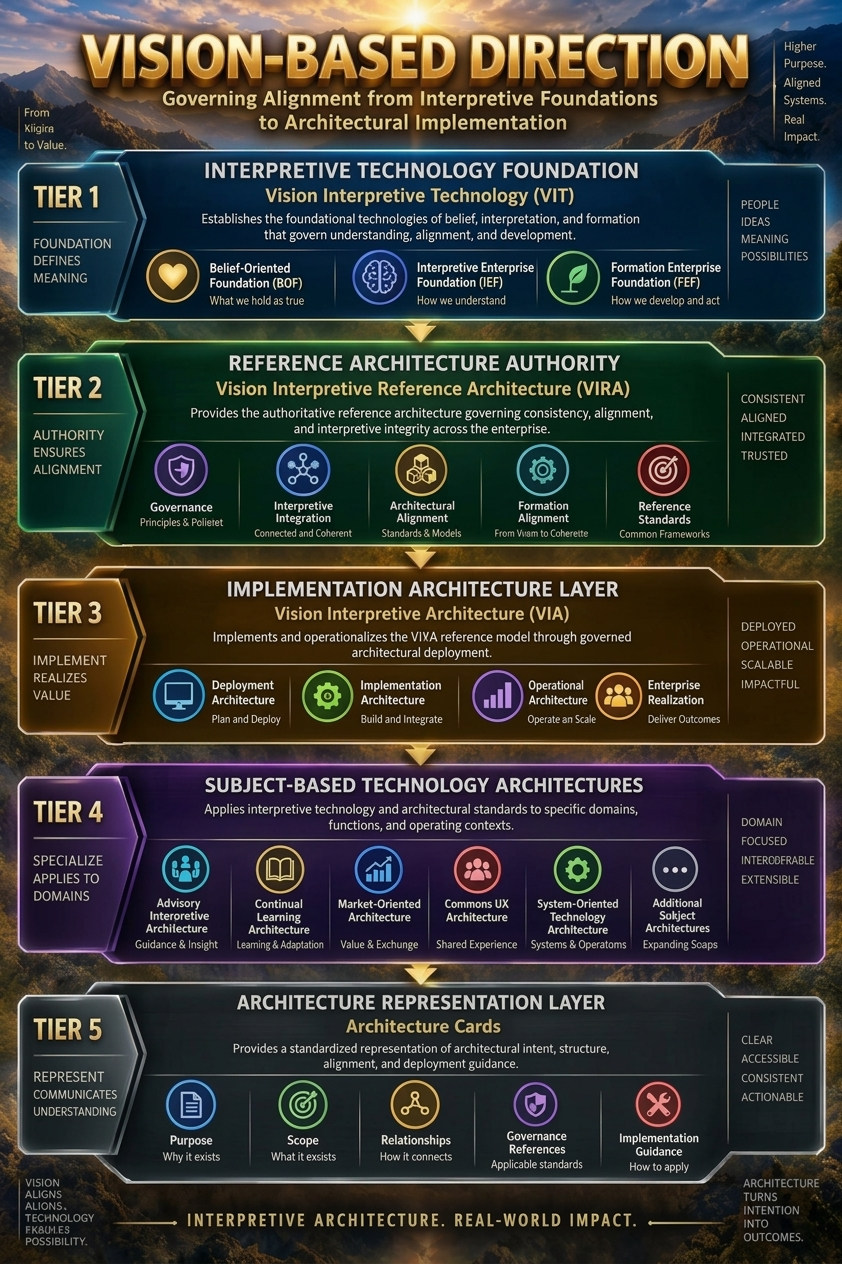
Vision-Based Direction is supported by a layered architectural framework that provides foundational, governance, reference authority, implementation, domain/portfolio subject based architecture, and architecture representation layer.
Vision-Based Architecture is a five-tier framework that connects vision to implementation through progressively detailed layers of governance, architecture, and execution. Tier 1 establishes the interpretive foundations. Tier 2 defines the authoritative reference architecture. Tier 3 provides implementation architecture through VIA. Tier 4 organizes subordinate architectures within a unified governance structure. Tier 5 contains Architecture Representation (Architecture Cards) that define the architectural attributes, relationships, and specifications required to design, assemble, and steward the Initiative ecosystem.
Architectural Constructs
Vision Interpretive Technology (VIT) establishes foundational governing principles. Vision Interpretive Reference Architecture (VIRA) provides authoritative reference models, standards, and alignment mechanisms that ensure consistency across initiatives, domains, portfolios, and implementations. Vision Interpretive Architecture (VIA) operationalizes these foundations through implementation architectures, services, workflows, and enabling technologies. Subject-based architectures extend these capabilities into specialized domain/portfolios such as learning, advisory, administrative, content, service, and participation environments. Architectural representations, models, and visual frameworks support communication, understanding, alignment, and stewardship by making relationships, dependencies, structures, and interpretive interactions visible across the enterprise ecosystem.
Constructs are the foundational interpretive and organizational elements required to establish, align, communicate, and operationalize Initiative vision throughout the enterprise.
- Interpretive Lens — the perspective through which information, experiences, relationships, and activities are understood and interpreted. The unified way of seeing that aligns how teams understand context and meaning.
- Directional Structure — the organizational framework that translates vision into aligned goals, initiatives, priorities, pathways, and activities. The architecture that ensures decisions and initiatives express the same long‑range intent.
- Narrative Coherence — ensures that vision, identity, purpose, beliefs, activities, and outcomes remain connected through a consistent and meaningful narrative. The system that keeps organizational storytelling, strategy, and movement aligned.
- Initiative Interpretation — the mechanisms through which initiatives are understood, evaluated, aligned, and communicated within the broader vision. The method for reading initiatives through vision rather than through isolated operational logic.
- UX Integration Capabilities -provide the user experience mechanisms through which vision, interpretation, participation, learning, advisory engagement, and stewardship become visible, accessible, and actionable. These capabilities integrate interpretive processes, workflows, content, relationships, and technologies into cohesive experiences that support understanding, engagement, and meaningful participation.
Vision Interpretation Attributes
Vision Interpretation
What does a Vision mean? How is it organized? Understood? How does implementation matter?
Vision Interpretation is the bridge between vision and realization. While vision establishes purpose, direction, and desired outcomes, interpretation provides the means through which that vision is understood, communicated, and applied across people, organizations, and systems. It transforms ideas into understanding, understanding into alignment, and alignment into meaningful participation. By creating a shared framework for making sense of experiences, information, opportunities, and challenges, Vision Interpretation helps ensure that decisions, actions, and development remain connected to the original purpose of the initiative. The result is greater clarity, stronger alignment, more effective stewardship, and a sustained ability to move vision forward with confidence and purpose.
Vision Interpretive Technology (VIT)
Vision Interpretive Technology (VIT) is a vision-centered framework for transforming belief, experience, information, and knowledge into understanding, formation, alignment, and meaningful action. Built on the principle that interpretation creates understanding, VIT provides the foundation for aligning people, organizations, processes, and technologies around a shared purpose. By connecting vision to understanding and understanding to action, VIT enables continual learning, stewardship, governance, and development within a unified interpretive environment. Ultimately, VIT transforms vision from something imagined into something understood, from something understood into something embraced, and from something embraced into something that shapes people, organizations, and outcomes for generations to come.
Vision Interpretive Reference Architecture (VIRA)
Vision Interpretive Reference Architecture (VIRA) is the authoritative reference architecture of Vision Interpretive Technology. VIRA defines the governing models, standards, principles, architectural constructs, and alignment mechanisms that guide the design, development, and stewardship of interpretive systems and enterprises. It provides the common reference framework through which vision, belief, interpretation, formation, participation, and governance remain consistently aligned across initiatives, portfolios, domains, and implementations. VIRA establishes the architectural boundaries, relationships, and patterns that ensure organizational expressions remain faithful to their foundational vision while enabling flexibility in deployment and operation through Vision Interpretive Architecture (VIA).
Vision Interpretive Architecture (VIA)
VIA is is the implementation and deployment architecture of Vision Interpretive Technology. VIA operationalizes the guidance of VIRA by organizing the services, workflows, technologies, content, relationships, and participation mechanisms required to support interpretive and formative activities. It provides the structures through which vision, interpretation, learning, advisory engagement, administration, stewardship, and continual development become executable within real-world environments. VIA transforms architectural intent into operational capability while maintaining alignment with governing foundations, reference models, and organizational purpose.
Traditional Architecture
A Traditional Technical Architecture is an architectural approach that organizes and describes an enterprise primarily through its technology components, infrastructure, applications, platforms, integrations, networks, data systems, and operational services. Its focus is on how technical capabilities are designed, connected, deployed, managed, secured, and maintained to support organizational objectives. Traditional technical architectures commonly include infrastructure architecture, application architecture, data architecture, integration architecture, security architecture, and operational architecture, providing detailed representations of technology assets and their relationships. While highly effective for governing technical environments and implementation decisions, traditional technical architecture is generally system-centered and technology-centered, emphasizing technical structures and operational concerns.
Infrastructure Architecture
Infrastructure Architecture explains how the internal parts of an organization quietly support everything people see on the surface. It focuses on the behind‑the‑scenes systems—records, permissions, workflows, and shared operational foundations—that keep programs stable, consistent, and trustworthy. While customers interact with visible services, Infrastructure Architecture ensures those services run smoothly by maintaining the organization’s internal coherence and integrity.
Vision Interpretive Marketplace Architecture (VIMA)
Vision Interpretive Marketplace Architecture (VIMA) is the marketplace reference architecture within the Vision Initiative ecosystem that governs how people, organizations, resources, offerings, opportunities, relationships, and participation interact within an interpretive environment. Rather than focusing solely on transactions, VIMA enables the discovery, interpretation, alignment, exchange, stewardship, and collaborative development of value around a shared vision. It provides the architectural structures through which participants move from exploration and understanding toward meaningful participation, contribution, formation, service, and sustainable engagement.
Interpretive Content Architecture
Content Interpretive Architecture helps people understand how meaning is shaped, communicated, and carried across an organization’s materials. It focuses on how messages, narratives, explanations, and visual elements work together so information feels clear, consistent, and purposeful. Rather than treating content as isolated pieces, this architecture shows how every article, guide, message, and visual contributes to a shared understanding. For the public, it offers a simple way to see that thoughtful content design isn’t just about words—it’s about creating coherence, trust, and clarity across everything an organization communicates.
Interpretive Capability Architecture
Interpretive Capability Architecture (ICA) is the architectural organization of the capabilities, services, environments, resources, roles, technologies, and governance mechanisms that enable observation, interpretation, understanding, formation, participation, and action within an Interpretive System. ICA defines what an Interpretive System is capable of doing, how those capabilities are organized, how they interact, and how they support interpretive outcomes in alignment with established beliefs, stewardship principles, governance structures, and organizational objectives. Unlike traditional capability architectures that focus primarily on operational execution and business functions, Interpretive Capability Architecture focuses on the capabilities required to create, steward, communicate, apply, and continually refine understanding.
Vision Interpretation Representative
Subject-Based Technology
A Subject-Based Technology is an architectural representation that organizes technology, interpretation, workflow, experience, and governance around a specific subject domain rather than around technical platforms, applications, or organizational structures. Within Vision Interpretive Technology (VIT), subject-based architectures provide focused architectural views that express how a particular mission, capability, experience, or interpretive function is realized across the enterprise. Examples include Advisory Interpretation, which governs advisory formation and interpretive guidance; Continual Learning, which supports learning progression and developmental formation; Market-Oriented, which organizes marketplace, participation, and value exchange capabilities; Commons UX, defines shared experience, interaction, and engagement patterns; and System-Oriented, which represents the underlying technical systems, operational components, and enabling technologies. Collectively, subject-based architectures provide specialized architectural perspectives while remaining aligned to the broader Vision-Based Direction, Reference Architecture, and Implementation Architecture, ensuring that each subject domain can be interpreted, developed, governed, and realized consistently within the enterprise.
Advisory Interpretation
Advisory Interpretation (content‑oriented) explains how Advisors (through Advisory Formation) help people understand the meaning behind an organization’s messages, materials, and explanations. It focuses on interpreting content so that guidance, direction, and decision‑making stay aligned with the organization’s purpose. Rather than simply reviewing documents or communications, advisors use interpretive skill to clarify intent, surface meaning, and ensure that content supports the right actions. For the public, this offers a simple idea: effective advisory work isn’t just about giving advice — it’s about interpreting content in a way that keeps understanding clear, consistent, and connected to the organization’s vision.
Continual Learning
Continual Learning explains how an organization strengthens its knowledge and capabilities through an ongoing relationship between Instructors and Students, supported by intentional transitions into networking opportunities and mentorship development. It focuses on the systems that help Instructors guide learning, interpret progress, and shape development, while Students engage with content, practice new skills, and build understanding over time. As learners advance, the architecture provides structured ways for them to connect with peers, mentors, and broader professional communities, turning learning into real‑world growth. Guided by Vision Interpretation, this architecture ensures that learning is continuous, relational, and purpose‑driven. For the public, it offers a simple idea: people grow most effectively when education, mentorship, and networking are woven together into one coherent learning environment.
Market-Oriented
Market‑Oriented programs explains how an organization understands the needs of its market and shapes its offerings, services, and experiences around real‑world value. It focuses on interpreting what communities, customers, and partners actually need — then aligning programs, content, and technology to meet those needs with clarity and purpose. Guided by Vision Interpretation, this architecture ensures that every offering is grounded in relevance, responsiveness, and meaningful impact. For the public, it offers a simple idea: organizations thrive when they listen closely to their market and design solutions that genuinely serve the people they aim to support.
System-Oriented Technology
How does the system actually run?
System‑Oriented Technology Architecture explains how an organization’s technology environment fits together as one coherent system rather than a collection of disconnected tools. It focuses on the structures, connections, and operational patterns that allow technology to support people, programs, and long‑term direction. Guided by Vision Interpretation, this architecture ensures that every system—data, workflow, integration, and tasks —works in alignment with the organization’s purpose. For the public, it offers a simple idea: reliable technology isn’t accidental; it comes from a clear architectural approach that keeps everything connected, stable, and moving in the same direction.
Commons UX (Commons-Based)
How does meaning become structured, stable, and usable?
Commons ( or Commons‑Based) UX explains how an organization creates shared, unified experiences across all of its digital spaces. Instead of designing each interface separately, this architecture focuses on the common patterns, interactions, and visual language that make everything feel connected and intuitive. Guided by Vision Interpretation, it ensures that every touchpoint—websites, user interfaces, tools, and applications—expresses the same clarity, values, and sense of belonging. For the public, it offers a simple idea: when experiences feel seamless and consistent, it’s because they are built from a shared Commons experience that keeps everything aligned and easy to navigate.
Additional Subject/Architecture
A key characteristic of Subject-Based Architecture is its ability to support continual expansion as new enterprise domains, missions, capabilities, and experiences emerge over time. Rather than prescribing a fixed set of architectural subjects, the architectural model intentionally accommodates future growth through the creation of additional subject-based architectures that address new areas of focus, service, formation, operations, technology, governance, or user experience. As the enterprise evolves, new architectural representations can be developed alongside existing architectures such as Advisory Interpretive Architecture, Continual Learning Architecture, Market-Oriented Architecture, Commons UX Architecture, and System-Oriented Architecture. Each new subject architecture provides a focused view of a specific domain while remaining aligned with Vision-Based Direction, Reference Architecture, and Implementation Architecture. This approach enables architectural scalability, preserves consistency across expanding capabilities, and allows the enterprise to continually develop new architectural perspectives without requiring changes to the foundational interpretive and implementation framework.
Architecture Representation (Architecture Cards)
Tier 5 Vision-Based Direction provides the practical directional layer that connects vision and architecture to implementation and enterprise realization. Each Tier 5 representation is organized around five core elements: Purpose, which defines why the architectural direction exists; Scope, which establishes its boundaries and areas of responsibility; Relationships, which describe how it connects to other architectures, domains, and enterprise capabilities; Governance References, which identify the principles, standards, policies, and authoritative guidance that govern it; and Implementation Guidance, which provides actionable direction for deployment, realization, and operational execution. Together, these five elements create a concise yet comprehensive framework that enables architectural consistency, supports informed decision-making, and guides the effective translation of vision into enterprise practice.