
Vision Interpretation

Overview
Vision Interpretation is the process through which vision becomes understandable, shareable, and actionable across people, organizations, and systems. While vision establishes purpose, direction, and desired outcomes, interpretation provides the framework through which that vision is examined, understood, communicated, and applied. It creates a shared context for making sense of experiences, information, opportunities, and challenges, helping participants align their understanding and actions with the intended purpose of the initiative. By transforming purpose into understanding and understanding into participation, Vision Interpretation strengthens alignment, stewardship, learning, governance, and meaningful action. Rather than allowing vision to remain an aspiration or statement of intent, it establishes a continual pathway from vision to realization. Ultimately, Vision Interpretation transforms vision from something imagined into something understood, from something understood into something embraced, and from something embraced into something that shapes people, organizations, and outcomes for generations to come.
Vision and Interpretation Collaboration
Together they create Direction informed by understanding
Vision contributes direction. Interpretation contributes understanding. Through continual collaboration they produce the alignment, formation, stewardship, and action necessary to realize meaningful futures.
Vision Interpretive Ecosystem
The Vision Interpretation Ecosystem is the collaborative environment in which vision is observed, explored, interpreted, understood, and formed into meaningful direction, alignment, and action. It provides the structures, relationships, processes, and governance necessary to connect vision with interpretation so that ideas, experiences, observations, beliefs, knowledge, and insights can be transformed into shared understanding. Rather than viewing vision as a static statement or interpretation as an isolated activity, the ecosystem recognizes both as interconnected and continually interacting elements within a larger framework of learning, formation, stewardship, and participation. Through this ongoing relationship, the Vision Interpretation Ecosystem enables individuals, organizations, and communities to move from seeing and understanding toward alignment, development, and purposeful action.
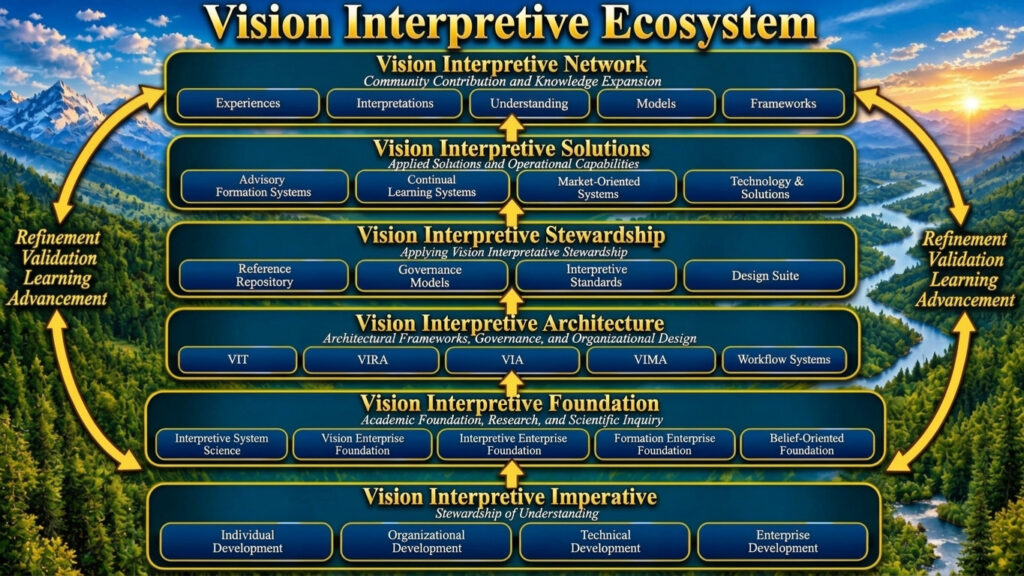
Vision Interpretive Ecosystem Details
- Vision Interpretive Network is a collaborative community of participants connected through the continual exchange of experiences, interpretations, understanding, models, and frameworks in pursuit of a shared vision. It serves as an environment where individuals contribute observations and experiences, engage in interpretation, develop understanding, and collectively create models and frameworks that expand knowledge across the network. As participation increases, the network becomes a self-reinforcing system of learning, formation, stewardship, and knowledge development, enabling vision to be continually refined, communicated, and operationalized through community engagement.
- Vision Interpretive Solutions is the applied implementation layer of the Vision Interpretation Ecosystem where understanding is transformed into operational capabilities, services, systems, and solutions. It provides the structures, methodologies, technologies, and organizational mechanisms necessary to translate vision, interpretation, and understanding into practical outcomes that support learning, stewardship, growth, and mission execution. Through the integration of advisory formation systems, continual learning systems, market-oriented systems, and technology solutions, Vision Interpretive Solutions enables organizations to operationalize understanding and create sustainable pathways for development, participation, and impact.
- Vision Interpretive Stewardship provides the governance and stewardship foundation that preserves the integrity, consistency, and continuity of vision, interpretation, and understanding across the ecosystem. It establishes the repositories, standards, governance models, and design resources necessary to ensure that knowledge, frameworks, and solutions remain aligned with their intended purpose and foundational principles. Through disciplined stewardship, organizations can manage growth, maintain interpretive consistency, support collaboration, and provide a trusted foundation for continual learning, participation, and development. The result is a sustainable environment where vision is protected, interpretation is governed, and understanding can be preserved and expanded over time.
- Vision Interpretive Architecture provides the architectural foundation that translates vision and interpretation into structured, governable, and scalable organizational designs. It establishes the architectural frameworks, governance structures, organizational models, and implementation patterns necessary to align people, processes, systems, and initiatives around a shared interpretive foundation. Through the coordinated application of Vision Interpretive Technology (VIT), Vision Interpretive Reference Architecture (VIRA), Vision Interpretive Architecture (VIA), Vision Interpretive Marketplace Architecture (VIMA), and supporting Workflow Systems, organizations gain a comprehensive blueprint for governance, operational alignment, participation, and sustainable growth. This architectural ecosystem enables vision to be systematically implemented, interpretation to be consistently governed, organizational structures to remain aligned with purpose, and marketplace interactions to support participation, stewardship, and continual development. The result is a cohesive and scalable environment where vision, architecture, governance, workflows, and ecosystem engagement work together to advance understanding, formation, and mission-driven outcomes.
- Vision Interpretive Foundation provides the academic, research, and scientific foundation for understanding how vision, belief, interpretation, formation, and organizational development interact within complex human and enterprise environments. It establishes the theoretical frameworks, foundational principles, research disciplines, and inquiry models that support the study and advancement of interpretive thought and practice. Through Interpretive System Science, Vision Enterprise Foundation, Interpretive Enterprise Foundation, Formation Enterprise Foundation, and Belief-Oriented Foundation, it creates a structured body of knowledge that enables rigorous exploration, validation, and continual refinement of interpretive concepts and methodologies. By grounding innovation, architecture, governance, and implementation in disciplined research and scholarly inquiry, Vision Interpretive Foundation provides the intellectual and scientific basis for sustainable understanding, meaningful formation, and the continual evolution of the Vision Interpretive ecosystem.
- Vision Interpretive Imperative provides the stewardship framework for ensuring that understanding is not merely acquired, but cultivated, sustained, and transformed into meaningful development across every dimension of life and enterprise. It recognizes that vision, interpretation, and understanding carry a responsibility that extends beyond knowledge into formation, growth, and purposeful action. Through a commitment to Individual Development, Organizational Development, Technical Development, and Enterprise Development, the Vision Interpretive Imperative establishes the principles and practices necessary to steward understanding from insight to implementation. Its focus is not simply on what is known, but on how understanding shapes people, strengthens organizations, advances capabilities, and enables sustainable enterprise growth. The result is a culture of intentional stewardship where understanding becomes a catalyst for continual formation, responsible leadership, organizational maturity, and lasting impact.
Vision and Interpretive Implementations
Vision Interpretive Foundations
Foundations
A Foundation is a stewarded domain of essential truth, principles, constructs, and capabilities that enables and governs a specific aspect of vision, interpretation, formation, or belief. Foundations operate collaboratively, provide enduring stability, and support the architectures, enterprises, and workflows that emerge from them.
- Belief – Oriented Foundation – if removed, the model will lose its governing source.
- Vision Foundation – if removed, the model loses direction and purpose.
- Interpretation Foundation – if removed, the model loses understanding
- Formation Foundation – If removed, the model loses development and transformation.
Vision Implementation
Vision contributes direction.
- Vision Purpose
- Vision Mission
- Vision Direction
- Stewardship of Vision
- Belief-Oriented Foundation
Interpretation Implementation
Interpretation contributes understanding.
- Interpretation System Science
- Interpretive Systems
- Interpretive Architecture
- Interpretive Enterprise
- Belief-Oriented Foundation
Foundations of Vision answers where and why. Foundations of Interpretation answers what and how. Together they create the conditions for purposeful understanding, intentional development, meaningful participation, and sustained action.
Vision Environment
The shift to a Vision Environment represents a fundamental evolution in how organizations think about direction and purpose. Traditional environments focus on immediate objectives, operational demands, or short-term outcomes. A Vision Environment focuses on cultivating a clear and compelling future that provides meaning, orientation, and continuity across the enterprise. It recognizes that the greatest challenge facing modern organizations is often not a lack of resources, information, or capability, but a lack of shared direction. By establishing and stewarding vision, organizations create a framework through which priorities can be aligned, decisions can be evaluated, and progress can be measured against a meaningful future. The organizations that learn to do this well will possess an enduring advantage because they will be developing not merely plans or initiatives, but a shared sense of purpose that inspires participation, sustains commitment, and guides long-term growth.
- Vision Environment → Produces direction, purpose, and alignment.
Foundations of Vision
Vision is the process through which purpose, direction, possibilities, and future outcomes are recognized and brought into focus. It provides orientation for individuals, organizations, and initiatives by establishing a meaningful future toward which development and action may be directed. The Foundations of Vision explore the principles, conditions, and relationships that enable vision to emerge, be communicated, and be stewarded over time. These foundations provide the basis for vision-centered systems, architectures, technologies, and practices that support alignment, governance, stewardship, participation, strategic development, and meaningful progress.
The Foundations of Vision include background references grounded in the basic insight that activity is not direction, goals are not purpose, and change is not vision. Behind these realizations lies a discipline of study. Vision System Science is the study of how purpose, possibility, aspiration, and future potential are recognized, articulated, stewarded, and transformed into shared direction, alignment, commitment, participation, and meaningful progress. It examines the principles, conditions, and relationships through which vision emerges, is sustained over time, and serves as a guiding influence for understanding, development, governance, and action.
Vision Purpose
Vision Purpose provides the meaning, intent, and significance that transform vision into a guiding force for individuals, organizations, and communities. It connects possibility with purpose, aligns aspiration with direction, and helps ensure that vision remains relevant, actionable, and enduring. Purpose establishes the reason vision exists, guides its stewardship, and provides a foundation for alignment, decision-making, and meaningful participation. Through these relationships, possibility becomes purpose, purpose becomes direction, and vision becomes meaningful progress, alignment, stewardship, and sustained development within the enterprise.
- Vision reveals a desired future.
- Purpose provides meaning and intent.
- Direction guides understanding and decision-making.
- Understanding informs and enables formation.
- Formation produces development and capability.
- Vision inspires participation and commitment.
- Alignment directs meaningful action.
Vision Mission
Vision Mission provides the commitment, focus, and stewardship necessary to transform vision into purposeful action. It establishes the pathway through which vision is pursued, communicated, supported, and realized across individuals, organizations, and communities. Mission aligns participants, priorities, resources, and activities around a common direction while creating continuity between purpose and implementation. By providing a framework for meaningful participation and coordinated effort, Mission helps ensure that vision is not merely understood but actively pursued. Through these relationships, purpose becomes mission, mission becomes commitment, and vision becomes coordinated action, meaningful participation, alignment, and sustained progress toward its intended future.
Vision Direction
Vision Direction provides the orientation, guidance, and clarity necessary to move vision toward realization. It transforms purpose and mission into an actionable course of movement, helping individuals, organizations, and communities understand where they are going and how they should proceed. Direction aligns decisions, priorities, resources, and efforts around a common path while providing a consistent framework for navigation, adaptation, and progress. By establishing a clear course forward, Vision Direction helps ensure that vision remains focused, coherent, and achievable. Through these relationships, mission becomes direction, direction becomes movement, and vision becomes aligned progress, purposeful advancement, and sustained pursuit of its intended future.
Stewardship of Vision
Vision is the ability to perceive, recognize, and articulate a desired future that is not yet fully realized. It provides a compelling view of what could be, what should be pursued, and what is worthy of stewardship, alignment, and meaningful action. Vision extends beyond aspiration by creating a framework through which possibility can be understood, evaluated, and developed into purposeful outcomes. Within the Vision Foundation, vision serves as the catalyst for purpose, the inspiration for mission, and the source of direction. Through these relationships, vision transforms possibility into opportunity, opportunity into purpose, and purpose into meaningful progress, alignment, and sustained development.
Belief-Oriented Foundation
Belief-Oriented Foundation (BOF) establishes the foundational truths, principles, and commitments that guide and sustain the VIT ecosystem. Anchored by The Word, The Way, Belief, Faith, and Love, BOF interacts with the Vision Foundation to provide stability, meaning, and direction. By grounding vision in enduring belief, BOF helps transform possibility into purpose, purpose into direction, and vision into meaningful progress, alignment, and sustained development.
Interpretive Environment
The shift to an Interpretive Environment represents a fundamental evolution in how organizations think about knowledge and development. Traditional environments focus on storing information, managing transactions, or automating tasks. An Interpretive Environment focuses on producing understanding and transforming that understanding into formation, alignment, participation, and meaningful action. It recognizes that the greatest challenge facing modern enterprises is not access to information but the ability to interpret information faithfully, steward understanding responsibly, and cultivate growth consistently. The organizations that learn to do this well will possess an enduring advantage because they will be developing not merely systems, but people, understanding, and purpose.
- Interpretive Environment → Produces understanding, formation, and meaningful action.
Foundation of Interpretation
Interpretation is the process through which meaning, understanding, relationships, and direction emerge from belief, experience, information, knowledge, and observation. Interpretation precedes understanding, understanding precedes formation, and formation precedes meaningful action and continual development. The Foundations of Interpretation explore the principles, conditions, and relationships that enable understanding to emerge and be stewarded over time. These foundations provide the basis for interpretive systems, architectures, technologies, and practices that support learning, governance, participation, alignment, and action.
The Foundations of Interpretation includes background references including the basic insight that we can all recognize information is not understanding, know is not formation, and data is not meaning. Behind these three realization is an discipline of study. Interpretive System Science is the study of how belief, experience, information, relationships, and knowledge are transformed through interpretation into understanding, formation, alignment, participation, and action.
Interpretive System Science studies how interpretation produces understanding.
Through these relationships, understanding becomes development, learning becomes growth, and interpretation becomes meaningful action.
- Experience provides what is encountered and observed.
- Belief Influences interpretation
- Interpretation creates understanding.
- Understanding informs and enables formation.
- Formation produces development – leads to action.
- Meaning guides participation.
- Alignment informs action.
Then the next level deals with an Interpretive System.
Interpretive Systems
Interpretive Systems provide the structures and conditions through which interpretation occurs. They establish the relationships among identity, authority, context, memory, participation, learning, formation, and stewardship, enabling understanding to be created, shared, refined, and applied. Interpretive Systems provide the operational environment in which interpretation becomes repeatable, governable, and sustainable across individuals, groups, and enterprises. Interpretive Systems create a new class of information services in which the primary managed resources are not merely data, information, knowledge, or system logic. This is why VIT doesn’t fit neatly into traditional systems like AI, knowledge management, analytics, enterprise architecture, or even learning systems. It effectively proposes that understanding itself is an enterprise resource, and that enterprise services can be intentionally designed to cultivate, govern, steward, and apply understanding within itself.
An Interpretive System is a system that facilitates the creation, refinement, stewardship, and application of understanding through the interpretation of belief, experience, information, knowledge, relationships, and context.
Then the next level becomes Interpretive Architecture.
Interpretive Architecture
Interpretive Architecture organizes and governs the structures of an Interpretive System. It defines the containers, constructs, roles, relationships, governance mechanisms, and interaction patterns through which interpretation is supported and managed. Interpretive Architecture does not create meaning or understanding; rather, it provides the framework within which meaning is interpreted, understanding is formed, and participation is aligned toward learning, development, stewardship, and action.
Interpretive Enterprise
An Interpretive Enterprise is an enterprise whose primary purpose is the creation, stewardship, application, and continual refinement of interpretation in support of understanding, formation, decision-making, alignment, service, and meaningful action. It provides an environment where belief, experience, information, and knowledge are examined and transformed into understanding through governed interpretive processes. Rather than treating information as an end in itself, the Interpretive Enterprise focuses on developing clarity, context, meaning, and insight that can guide individuals, organizations, and communities toward purposeful participation and responsible stewardship. Through these relationships, observation becomes interpretation, interpretation becomes understanding, and understanding becomes alignment, formation, and meaningful action.
Belief-Oriented Foundation
Belief-Oriented Foundation forms the starting point of all interpretation and provides the foundational beliefs that give meaning to experience, shape understanding, and guide action. By bringing these roots into view, organizations and individuals gain greater clarity about how interpretation occurs, why perspectives differ, and how shared understanding can be cultivated. Within the Foundations of Interpretation, the Belief-Oriented Foundation provides the grounding from which coherent interpretation, meaningful formation, and aligned participation emerge.