
Vision Interpretive Technology (VIT) Center
Overview
To provide a framework through which understanding, alignment, wisdom, development, and action may be cultivated through spiritually guided interpretation and faithful stewardship.
Vision Interpretive Technology (VIT) is the Initiative’s internal system that houses, organizes, and governs the full Vision Interpretation Architecture rule set. VIT is the interpretive container—not an applied layer—where foundational constructs, structural relationships, domain logic, belief‑aligned frameworks, and narrative components are a ssembled into a coherent interpretive system. Through its layered composition—Foundational/Conceptual Layers, and its Component Constructs, including Core Environments, Workflow Logic, Role‑Aligned Meaning Models, and Commons‑based relational patterns—VIT generates the governing rules that determine how vision is understood, constrained, expressed, and translated across all Initiative domains. In this role, VIT serves as the architectural locus where meaning becomes formally defined and where the Vision Interpretation Architecture emerges as a stable, reusable, domain‑agnostic interpretive framework.
For VIT, discerning how a system is built is in fact how development is formed. Not a software framework. Not a business framework. Not a ministry framework. VIT is an Interpretive-Formative Enterprise Framework. A framework for governing how understanding becomes development within individuals, communities, ministries, businesses, and enterprises.
Introduction
A VIT-based technology system is a governed interpretive system that transforms prompts, information, experience, and belief into understanding, alignment, formation, and authorized action through defined interpretive, formative, and governance structures.
Vision Interpretive Architecture Reference
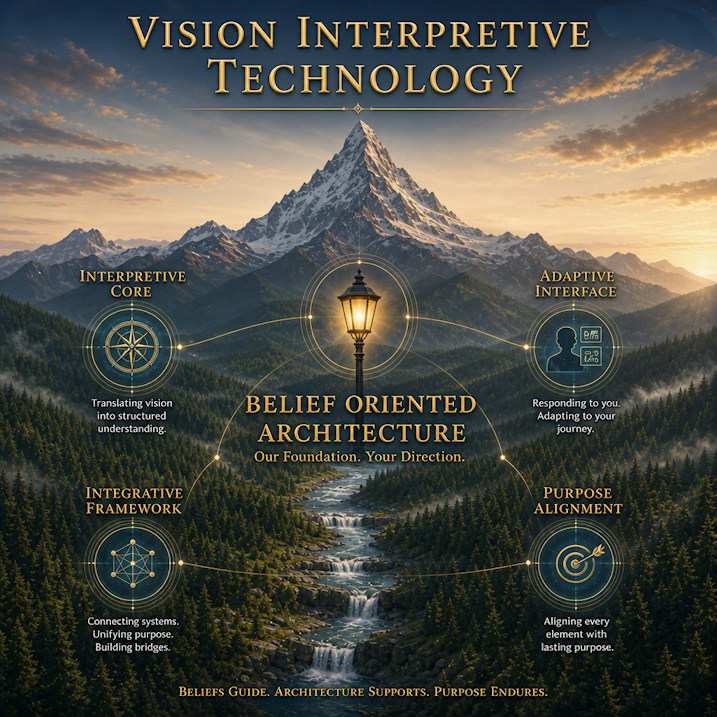
Together, VIT Conceptual Layers form the complete interpretive definitions of Vision Interpretive Technology. The Interpretive Core establishes foundational meaning and structural truth; the Adaptive Interface expresses that meaning dynamically through interaction; the Integrative Framework maintains coherence across all Initiative domains; Purpose Alignment ensures every interpretive action remains anchored to the Initiative’s directional intent; and the Belief‑Oriented Architecture grounds the entire system in the Initiative’s core convictions. Together, these layers create a unified interpretive system that stabilizes identity, governs meaning, and ensures cohent operations.
VIT Conceptual/Foundational Layers
Interpretive Core
The Interpretive Core is the central meaning‑governing construct within Vision Interpretive Technology (VIT) — the locus where foundational truth is translated into structured interpretive logic. It serves as the Initiative’s internal mechanism for stabilizing meaning, defining directional intent, and generating the rule sets that shape how every domain understands and expresses vision. The Interpretive Core organizes foundational constructs, structural relationships, role‑aligned meaning models, and Commons‑based patterns into a coherent interpretive engine that governs how vision becomes formally defined and consistently applied. In practice, it ensures that BrightStone, PathStone, LifeLong, and HearthStone operate from the same interpretive truth, providing the stable center from which all VIT layers derive coherence, alignment, and architectural integrity.
Adaptive Interface
The Adaptive Interface is VIT’s dynamic expression layer, translating the rules of the Interpretive Core into real‑time interaction behavior. It adjusts structure, emphasis, and flow based on contextual signals and role‑aligned meaning models, ensuring that every user experience reflects the Initiative’s interpretive logic. Rather than providing cosmetic variation, the Adaptive Interface makes interpretation experiential, allowing BrightStone, PathStone, LifeLong, and HearthStone to present interactions that remain coherent, purpose‑aligned, and governed by VIT’s internal rule set.
Integrative Framework
The Integrative Framework is VIT’s cross‑domain alignment system, ensuring that the interpretive rules generated by the Interpretive Core and expressed through the Adaptive Interface remain coherent across every Initiative domain. It synchronizes structural constructs, workflow logic, and meaning models so BrightStone, PathStone, LifeLong, and HearthStone operate as a unified interpretive ecosystem rather than isolated environments. The Integrative Framework prevents drift, maintains continuity, and guarantees that all domains express the Initiative’s identity and direction consistently, making it the architectural mechanism that binds VIT’s layers into one stable, interoperable system.
Purpose Alignment
Purpose Alignment is the directional stabilizer within Vision Interpretive Technology (VIT) — the mechanism that ensures every interpretive rule, structural construct, and interface behavior remains anchored to the Initiative’s core intent. While the Interpretive Core defines meaning and the Adaptive Interface expresses it, Purpose Alignment guarantees that both stay pointed toward the same strategic north star. It prevents drift, reinforces directional coherence, and shapes what the system emphasizes or de‑emphasizes across contexts. In practice, Purpose Alignment ensures that BrightStone, PathStone, LifeLong, and HearthStone consistently express the Initiative’s purpose, making it the layer that keeps interpretation intentional, stable, and directionally true.
VIT Technology Layers
VIT Architecture
VIT Technical Relations
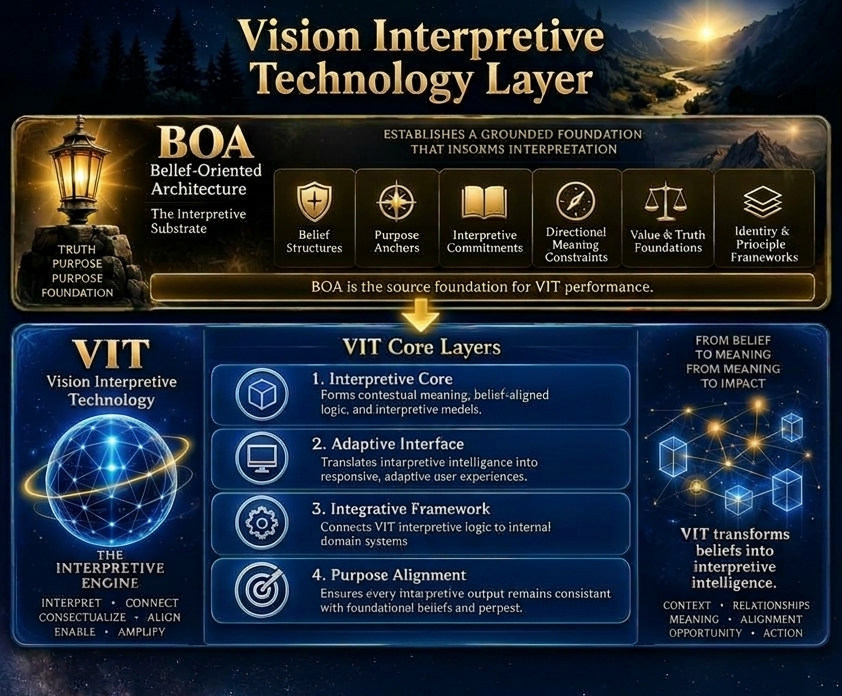
Vision Interpretive Technology (VIT) establishes a structured network of technical relationships that unify interpretive logic, adaptive intelligence, and integrative frameworks into a coherent operational system. Each relationship within VIT functions as a conduit between interpretive formation and domain execution, ensuring that belief‑aligned meaning is preserved through every technical layer. The Interpretive Core governs semantic translation and contextual reasoning; the Adaptive Interface manages dynamic interaction between interpretive logic and user environments; the Integrative Framework connects VIT’s internal logic to external systems such as VIAS (a VIT based process layer); and the Purpose Alignment layer maintains directional coherence with the Belief‑Oriented Architecture (BOA). Together, these relationships form a continuous interpretive circuit — belief informs interpretation, interpretation drives adaptation, adaptation enables integration, and integration expresses purpose — defining VIT as the governing technical system of interpretive technology.
VIT Component Constructs
The VIT Component Constructs are the operational mechanisms inside Vision Interpretive Technology (VIT) that make its conceptual layers actionable. These constructs include the Core Environments where foundational meaning is formed and stabilized; the Workflow Logic that governs how interpretation moves and transforms across contexts; the Role‑Aligned Meaning Models that tailor interpretive output to the identity and purpose of each Initiative role; and Relational Patterns that maintain coherence across BrightStone, PathStone, LifeLong, and HearthStone. Together, these constructs ensure that VIT’s interpretive rules are consistently applied, structurally stable, and cross‑domain aligned, forming the internal machinery that allows the Vision Interpretation Architecture to function as a unified, reusable interpretive system. Components can be traced to all of VIT based implementations and are often not hierarchical in relation,
Technology Comparison
As stated previously, Vision Interpretive Technology (VIT) is utilized as the internal interpretive system, responsible for defining how meaning, direction, and structural truth are established across all domains. VIT contains and governs the full Vision Interpretation Architecture rule set, organizing foundational layers, structural constructs, interpretive environments, workflow logic, role‑aligned meaning models, and Commons‑based relational patterns into a unified interpretive framework. Its purpose is conceptual governance: VIT determines how vision is understood, constrained, and expressed, ensuring that BrightStone, PathStone, LifeLong, and HearthStone operate from a consistent and coherent interpretive foundation.
Traditional technologies and architectures serve a fundamentally different role. They are external operational systems designed to execute tasks, manage data, automate workflows, integrate components, and deliver functional outcomes. Their layers—software modules, APIs, data pipelines, and infrastructure—define mechanics rather than meaning. Their outputs are functional rather than interpretive. Traditional systems adapt through updates and integrations; VIT adapts by recalibrating meaning and rule sets as vision evolves. This distinction is strategic: traditional technologies support organizational operation, while VIT governs organizational coherence. VIT defines the rules; traditional architectures operate within them.
As the Initiative expands, VIT provides the stable interpretive core that ensures every domain expresses identity, purpose, and relational meaning with precision. It is the architectural locus where conceptual truth is formalized, where direction is stabilized, and where the Initiative’s vision becomes structurally actionable across all environments. In executive terms, VIT is not a technology platform — it is the governing system that ensures the Initiative’s vision remains coherent, aligned, and interpretable at scale. A comparison of more traditional concepts illustrate the originality of an view and vision based implementation and not one reliant on technical constraints,
Enterprise Architecture (EA)
EA tries to unify business + technology, but:
- it is hierarchical
- it is static
- it is programming‑dependent
- it does not express worldview
- it does not integrate meaning, learning, or market identity
EA is a systems discipline, not a view discipline.
Design Thinking
Design thinking uses “views” (empathy, reframing), but:
- it is not architectural
- it does not govern systems
- it does not integrate multiple architectures
- it is not operational
It is a method, not an architecture.
Service‑Dominant Logic (SDL)
SDL reframes business as service ecosystems, but:
- it is economic theory
- it does not define workflow engines
- it does not govern technical execution
- it does not integrate learning or interpretive meaning
It is a logic, not an architecture.
Systems Thinking
Systems thinking uses holistic views, but:
- it is conceptual
- it is not operational
- it does not define architecture
- it does not integrate market delivery
- it does not interact with AI
It is a lens, not a governing architecture.
Digital Twins / Model‑Based Systems Engineering
These create unified “views” of systems, but:
- they are technical
- they are engineering‑centric
- they do not integrate meaning or learning
- they do not govern organizational identity
They are representations, not worldviews.