
Vision Interpretive Architecture
Overview
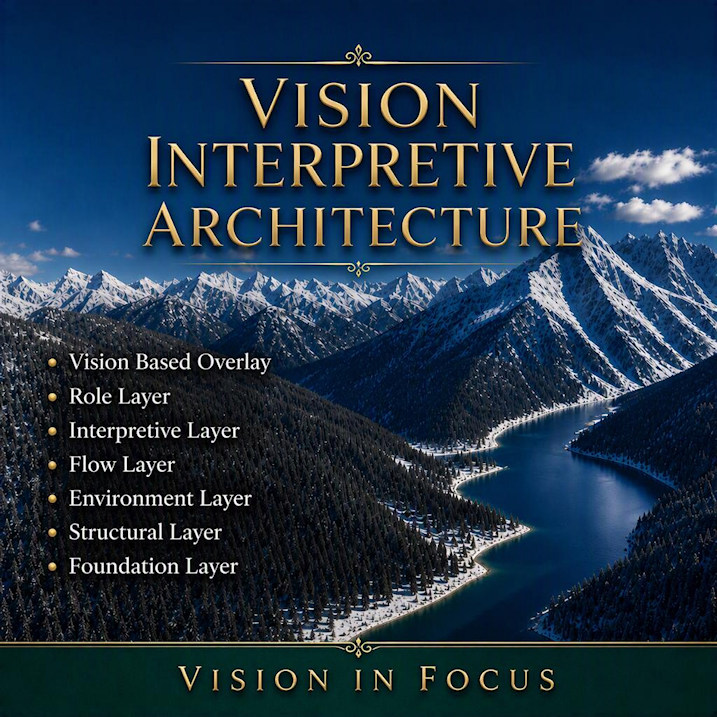
Vision Interpretive Architecture (VIA) is the discipline of building systems where a shared vision becomes the lens that interprets everything—strategy, structure, movement, and meaning. It aligns teams around a unifying way of seeing, so decisions aren’t made in isolation but flow from a coherent interpretive center. By anchoring every action to vision‑driven understanding, it creates organizations that move with clarity, design with intention, and communicate with enduring narrative strength.
How does this form within There and Back’s Initiative? Vision–Interpretive Architecture (VIA) is the Initiative’s governing architectural system that defines how all structures, systems, roles, engines, and interactions are interpreted, aligned, and routed through Vision. VIA establishes the Initiative’s interpretive identity, its directional logic, and the rules of interaction for both humans and AI operating within mission‑aligned boundaries. VIA, then is not category, it is the implementation,
Vision Through Perspective Versions
- Strategic version — Vision Interpretive Architecture transforms vision from a slogan into an operating system. It provides a structured interpretive framework that guides how teams read context, evaluate choices, and build systems. The result is an organization whose actions consistently express its identity and whose structures reinforce long‑term direction.
- Creative brand version — Vision Interpretive Architecture turns vision into a design language. It shapes how ideas are formed, how experiences are crafted, and how meaning is communicated. Every element becomes an expression of the same interpretive DNA, producing brands that feel unified, intentional, and unmistakably themselves.
- Executive leadership version — Vision Interpretive Architecture gives leaders a disciplined way to translate vision into organizational behavior. It aligns interpretation across teams, reduces noise in decision‑making, and ensures that strategy, operations, and culture all move in the same direction. Leaders gain a framework that makes vision actionable, durable, and consistently expressed.
VIA – Implementation (DRNBK)
DRNBK’s implementation of VIA becomes the governing view that orients, integrates, and relates all subordinate architectures, workflow engines, missions, and learning systems into one coherent operating model. This positions VIA exactly where it belongs:
- as DRNBK’s architectural worldview relies on this driving message – Businesses have ministries, ministries have businesses.
- as DRNBK’s governing perspective unifies DRNBK’s meaning.
- as DRNBK’s structural identity such as execution, delivery, and learning should be formed into a coherent system.
Introduction
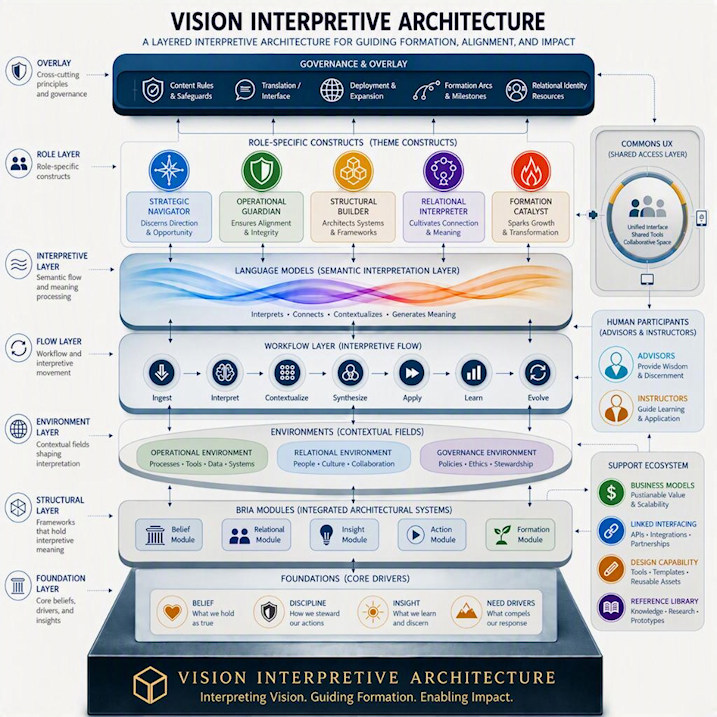
The Vision Interpretive Architecture breakdown transforms vision into a structured, actionable system that leaders can actually use. It separates vision into four integrated components: the unified interpretive lens that aligns how teams see meaning, the directional structural spine that guides decisions, the coherent narrative field that keeps messaging and movement aligned, and the initiative‑level interpretive method that ensures every effort expresses the same intent. This breakdown turns vision from an abstract statement into a disciplined interpretive engine—one that drives clarity, coherence, and strategic momentum across the entire organization. The hierarchical relationship of Vision based direction is:
- Vision Interpretative Reference Architecture (VIRA) = the discipline
- Vision Interpretive Architecture (VIA) = the governing architecture inside There & Back
- VisionView = the Commons‑UX implementation of VIA
ViA Constructs Definition
- Interpretive Lens — VIA deploys and applies the interpretive lens throughout the enterprise ecosystem.
- Directional Structure — The architecture that ensures decisions and initiatives express the same long‑range intent.
- Narrative Coherence — VIA implements Narrative Coherence by aligning vision, purpose, content, experiences, initiatives, and operational activities within a consistent interpretive framework.
- Initiative Interpretation — VIA implements Initiative Interpretation by connecting initiatives to vision, purpose, governance, and enterprise objectives.
- Commons Integration — How VIA anchors interpretation within shared organizational meaning structures like VisionView.
Construct Interactions
- Interpretive Lens answers: “How do we understand?”
- Directional Structure answers: “Where are we going and how do we align action to get there?”
- Narrative Coherence answers: “How do we maintain consistency of meaning and purpose?”
- Initiative Interpretation answers: “How do we understand the purpose and contribution of initiatives within the larger vision.?”
- Commons Integration – “How will people, resources, and activities participate within a shared interpretive ecosystem?”
VIA Constructs
Interpretive Lens
Within Vision Interpretive Architecture (VIA), the Interpretive Lens is implemented as a deployable enterprise capability that shapes how information, experiences, relationships, content, initiatives, and activities are presented, evaluated, and understood. VIA integrates the Interpretive Lens into workflows, user experiences, content structures, participation models, advisory processes, learning processes, and domain-specific technologies to ensure that interpretation remains consistent with established vision, purpose, governance, and enterprise objectives. Through this implementation, the Interpretive Lens provides a practical mechanism for aligning understanding, decision-making, communication, and participation across initiatives, communities, and operational environments.
- Embeds interpretive perspectives into workflows and operational processes.
- Integrates interpretive context into user experiences and participation models.
- Aligns content, communications, and initiatives with vision and purpose.
- Applies consistent interpretive patterns across domain-specific technologies
- .Supports understanding, decision-making, engagement, and stewardship through governed interpretation.
Directional Structure
VIA implements Directional Structure by translating vision into executable architectures, workflows, initiatives, and participation models. It provides the operational mechanisms that align priorities, resources, technologies, and activities with established objectives, ensuring that strategic direction remains connected to implementation, engagement, and measurable outcomes across the enterprise ecosystem.
Narrative Coherence
Within Vision Interpretive Architecture (VIA), Narrative Coherence is implemented as the architectural capability that maintains consistency between vision, identity, purpose, beliefs, initiatives, participation, and outcomes. VIA integrates narrative coherence across workflows, content, user experiences, services, communications, and domain-specific technologies, ensuring that stakeholders encounter a unified and meaningful understanding of the enterprise vision. By preserving alignment between what is communicated, what is experienced, and what is implemented, VIA supports trust, continuity, understanding, and long-term interpretive alignment across communities, initiatives, and operational environments.
Initiative Interpretation
Within Vision Interpretive Architecture (VIA), Initiative Interpretation is implemented as the capability that provides context, meaning, and alignment for initiatives across the enterprise ecosystem. VIA integrates interpretive frameworks, governance guidance, workflows, content, and user experiences to help stakeholders understand why an initiative exists, how it supports the broader vision and mission, and how it relates to other initiatives, communities, and operational activities. By establishing a consistent interpretive context, VIA enables informed participation, aligned decision-making, effective communication, and meaningful stewardship throughout the initiative lifecycle.
Commons Integration
Within Vision Interpretive Architecture (VIA), Commons Integration is implemented as the capability that connects initiatives, communities, content, services, participation models, and interpretive processes within a shared enterprise environment. VIA provides the architectural mechanisms that enable collaboration, resource sharing, continual learning, advisory engagement, stewardship, and meaningful participation across the Commons. By integrating people, relationships, knowledge, workflows, and technologies within a common interpretive framework, VIA supports alignment, interoperability, and collective contribution while preserving coherence with vision, mission, governance, and enterprise objectives.