
Vision Interpretation Reference Architecture (VIRA)
Overview
To steward interpretation as a governed practice through which belief, experience, and knowledge become understanding, formation, alignment, and meaningful action.
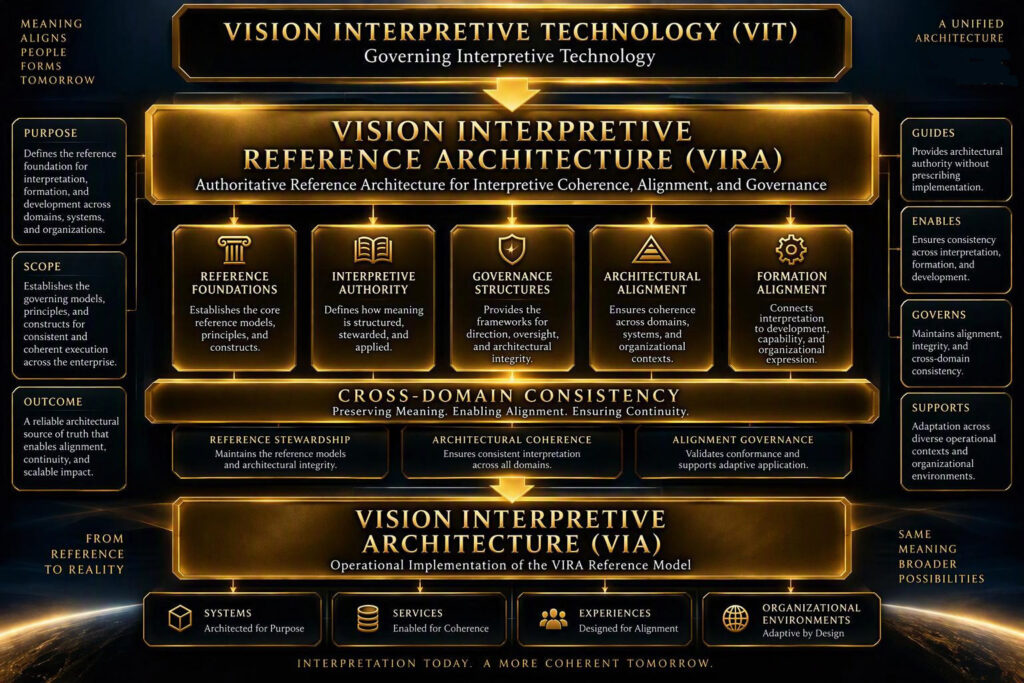
Vision Interpretive Reference Architecture (VIRA) is the authoritative reference architecture of Vision Interpretive Technology (VIT). It defines the governing interpretive structures, reference models, architectural principles, alignment constructs, and governance mechanisms that enable consistent interpretation, formation, and development across domains, systems, organizations, and initiatives. Rather than prescribing implementation, VIRA establishes the reference foundation against which implementation architectures, workflows, services, experiences, and operational models are aligned. It serves as the architectural source of truth for interpretive coherence, ensuring that meaning, purpose, formation, and organizational direction remain consistent while allowing implementations to adapt to varying operational contexts. At its core, VIRA defines how interpretation is governed, how meaning is structured, and how understanding is translated into formation and development. Through its reference models, VIRA provides the architectural patterns, governing constructs, role definitions, workflow relationships, and alignment mechanisms necessary to maintain consistency between belief, interpretation, learning, formation, and action. As the reference architecture beneath Vision Interpretive Technology, VIRA governs architectural alignment across both Interpretive Enterprise and Formative Enterprise functions. It establishes the frameworks through which organizations create shared understanding, preserve interpretive integrity, steward formation, and maintain cross-domain consistency. In doing so, VIRA enables the reliable translation of purpose into architecture, architecture into operation, and operation into continual learning and development. VIRA is implemented through Vision Interpretive Architecture (VIA), the deployed architecture that operationalizes the VIRA reference model. While VIRA defines what must be governed, aligned, and preserved, VIA defines how those reference principles are instantiated within real systems, experiences, workflows, services, and organizational environments. Together, VIRA and VIA provide the bridge between authoritative reference architecture and operational implementation. Within the VIT ecosystem, VIRA serves as the governing architectural authority for interpretive consistency, formation alignment, reference stewardship, and architectural coherence, ensuring that understanding and development remain inseparable expressions of the same interpretive foundation.
- Domains answer: What areas does VIRA govern?
- Layers answer: At what level of abstraction does VIRA operate?
Vision Interpretive Technology
Vision Interpretive Technology (VIT) is the Initiative’s digital translation engine — the system that turns conceptual vision into living experience. It transforms abstract purpose into interactive clarity, guiding users through environments that think, respond, and evolve. VIT’s design is rooted in Belief‑Oriented Architecture, ensuring every interaction reflects meaning and direction. Through its Interpretive Core, Adaptive Interface, Integrative Framework, and Purpose Alignment, VIT creates a seamless bridge between vision and technology — where belief guides architecture, and architecture supports purpose. Outside of the There and Back Initiative, the term would address the need to present technical and business directions for faith based organizations.
Definition
Vision Interpretive Technology (VIT) is the governing interpretive technology foundation that enables the creation and operation of Interpretive Enterprises and Formative Enterprises. VIT establishes the principles, constructs, governance structures, roles, workflows, and supporting technologies required to transform prompts, information, experience, knowledge, and belief into understanding, alignment, formation, development, stewardship, and authorized action. Within VIT, interpretation creates understanding, formation transforms understanding into development, and governance ensures alignment between belief, purpose, responsibility, and action.
VIT governs, VIRA defines, and VIA implements.
Vision Interpretive Technology (VIT) is the governing interpretive technology framework under which the Vision Interpretive Reference Architecture (VIRA) defines authoritative reference structures and the Vision Interpretive Architecture (VIA) implements those structures in operational systems.
Belief Oriented Architecture (BOA) Aspect of VIT
Belief‑Oriented Architecture is a type of interpretive architecture that defines how meaning is formed and how identity is understood before any structural or operational architecture exists. It establishes the belief‑level lens through which all other architectures are realized, allowing many different architectural forms to express the same underlying worldview. In practice, BOA provides the interpretive posture — the belief‑driven way of seeing — while the actual implementations can vary widely. That’s why a platform like There and Back, with multiple offerings for online businesses and ministries, can all be distinct architectures yet still express one Belief‑Oriented Architecture. Its motto, “Businesses have ministries. Ministries have businesses,” is the belief anchor that shapes every downstream structure without prescribing any single architectural form.
Interpretive System Aspect of VIT
An Interpretive System is a system whose primary concern is the creation, continuity, refinement, transfer, stewardship, and application of understanding through interpretation. Interpretive Systems establish and sustain the conditions through which belief, identity, authority, context, relationships, memory, learning, formation, participation, and stewardship interact to influence understanding over time. Their purpose is not merely to organize information, resources, or processes, but to create and sustain understanding as a distinct system concern capable of supporting alignment, participation, decision-making, service, development, and action.
Vision Aspect
What Does a Vision Mean?
A vision is not a slogan or a statement — it is the interpretive core of an organization. In a Interpretive Architecture, a vision is understood as the meaning‑structure that defines how an organization sees the world, understands itself, and decides how to move. A vision is the organization’s identity in motion: the enduring truth of who it is, expressed as a directional force. As believers, we understand this is an area that relies on relationship with the Lord, and the source of our direction. Visions shape how teams read context, how leaders make decisions, and how systems have to behave. When architected correctly, a vision becomes a shared interpretive lens, giving everyone the same way of understanding what matters, what is emerging, and what direction aligns with identity. VIRA turns vision from inspiration into operational meaning — a structured, coherent system that guides interpretation, anchors identity, and governs movement.
Vision Definition
“And the LORD answered me, and said, Write the vision, and make it plain upon tables, that he may run that readeth it.” – Habakkuk 2:2 (KJV)
Understanding is not a byproduct of information. It is received, interpreted, formed, and handed on. Interpretive Systems, which VIRA is reference part of. exist to make that possible: to write the vision and make it plain, so that those who receive it can understand it, be formed by it, and carry it into faithful action. Where much of modern technology gathers behavior in order to predict and steer it, Interpretive Systems begin with a prior question: what is being understood, by whom, and toward what end? They treat people as participants in the formation of understanding, not as sources of data, and they hold that understanding must be stewarded over time, not engineered or exploited.
How is it Organized?
In summary then, a vision is organized as a living architecture of meaning—not a sentence, not a slogan, but a structured system that shapes how an organization sees, understands, and moves. In Interpretive Architecture, a vision is built as a coherent interpretive framework: an identity core that defines who you are, meaning structures that stabilize how that identity is understood, a pattern language that makes the vision wowand repeatable, interpretive pathways that guide people through clarity, and narrative alignment that ensures every expression tells the same story. When a vision is organized architecturally, it becomes a shared lens that aligns teams, informs decisions, and anchors direction. It transforms vision from inspiration into operational meaning—a system people can actually use.
Vision Interpretive Reference Architecture Information
VIRA Layer Reference
Interpretation creates understanding. Formation transforms understanding into development. Layers become the enterprise progression from vision to development, while the domains provide the governance and stewardship within each layer.
- Vision Layer
- Interpretive Layer
- Architectural Layer
- Governance Layer
- Formation Layer
Vision Roles and VIRA
Vision Interpretive Technology (VIT) provides the governing interpretive foundation, Vision Interpretive Reference Architecture (VIRA) defines the authoritative reference models and alignment structures, and Vision Interpretive Architecture (VIA) implements those models within operational environments. Together, VIT governs, VIRA defines, and VIA implements.
- Vision Interpretive Reference Architecture (VIRA) = the discipline
- Vision Interpretive Architecture (VIA) = the governing architecture inside There & Back
- VisionView = the Commons‑UX implementation of VIA
Three Tier (VIRA/VIA/VisionView)
VIRA, VIA, and VisionView operate as a three-tier architectural continuum. VIRA (Vision Interpretive Reference Architecture) provides the authoritative reference models, governance structures, and alignment standards. VIA (Vision Interpretive Architecture) implements and operationalizes those reference models within systems, services, and environments. VisionView serves as the Commons-Based User Experience layer, where individuals and organizations engage with resources, services, and experiences. Together, VIRA defines, VIA implements, and VisionView engages, creating a continuous cycle in which experience and learning inform implementation, and implementation informs ongoing architectural refinement.
- VIT (Vision Interpretive Technology) is the governing interpretive technology umbrella.
- VIRA (Vision Interpretive Reference Architecture) is the authoritative reference architecture.
- VIA (Vision Interpretive Architecture) is the deployed implementation architecture that operationalizes VIRA.
- VIRA governs reference foundations, interpretive authority, governance structures, architectural alignment, formation alignment, and cross-domain consistency.
- VIA implements both the Interpretive Enterprise and Formative Enterprise functions according to the VIRA reference model.
Architecture Type
Vision Interpretation Reference Architecture is the defining interpretive discipline that makes a Belief‑Oriented Architecture system usable, coherent, and structurally actionable. It encapsulates belief by giving it form, boundaries, and relational movement, ensuring that belief is not merely held but architecturally expressed. Through its interpretive logic, VIRA translates belief into meaning, meaning into guidance, and guidance into operational architecture, stabilizing how belief flows through systems, roles, and environments. This allows Belief‑Oriented Architecture to function as more than a worldview — it becomes a governable structure capable of shaping workflows, aligning identity, and informing Commons‑UX expression. In this way, Vision Interpretation Reference Architecture is essential: it provides the defining framework that turns belief into architecture, architecture into experience, and experience into impact.
VIRA Reference Domains
VIRA Reference Domains are the primary architectural domains through which the Vision Interpretive Reference Architecture establishes interpretive foundations, governance, alignment, and formative stewardship across the enterprise. Together, they provide the authoritative framework that guides understanding, architectural consistency, organizational stewardship, and developmental outcomes. VIRA is organized into five governing domains: Reference Foundations, Interpretive Authority, Architecture Alignment, Governance Structures, and Formation Alignment.
Interpretive Authority
Interpretive Authority is the governed responsibility and capacity to establish, steward, validate, and maintain the interpretive frameworks, reference models, principles, definitions, and alignment standards through which understanding is formed and applied. Within VIRA, Interpretive Authority ensures that interpretation remains consistent, coherent, and aligned with foundational beliefs, governing constructs, and architectural intent across all domains, implementations, and organizational activities.
Interpretive Pathways
Interpretive Pathway is a governed progression of interpretation through which individuals, organizations, and initiatives move from foundational belief and vision toward understanding, formation, alignment, decision-making, and meaningful action. Interpretive Pathways provide the structured routes through which Interpretive Authority is applied consistently across domains, workflows, and implementations.
How people move through ideas, spaces, or systems, Interpretive pathways are the public‑facing way to explain how people move through meaning with clarity. They are the guided routes that help someone understand what’s happening, see what matters, and recognize the direction that aligns with who they are or what the organization is becoming. Instead of giving advice or instructions, interpretive pathways create a structured experience of clarity.
Pattern Language
Recurring forms that stabilize interpretation. Pattern language is the public‑facing way to explain how an organization creates repeatable forms of meaning. It is the shared vocabulary—the set of stable patterns—that helps people understand situations the same way, make decisions with clarity, and stay aligned with the organization’s identity. Pattern language turns meaning into something structured, consistent, and easy to navigate.
Relational patterns are the public‑facing way to explain how an organization’s meanings fit together. They show how ideas connect, support, contrast, or depend on one another, giving people a clear, structured way to understand the organization’s identity, direction, and decisions. Instead of treating meaning as isolated statements, relational patterns turn it into a coherent network.
Architecture Alignment
Within VIRA, Architecture Alignment is the governing function that evaluates, guides, and maintains consistency between interpretive intent and architectural execution. It ensures that deployed architectures, operating models, workflows, solutions, and organizational structures faithfully implement the principles, standards, and reference constructs established by the Vision Interpretive Reference Architecture.
Pattern Conformance
Within VIRA, Pattern Conformance is the Architectural Alignment governance function responsible for evaluating and validating the consistent application of approved interpretive, architectural, and formative patterns. It ensures that implementations, workflows, organizational structures, and participant experiences remain aligned with VIRA’s interpretive authority, architectural standards, and intended formative outcomes, thereby preserving enterprise-wide coherence, alignment, and integrity.
Pattern Conformance ensures that implementations align with the interpretive and architectural patterns established by VIRA, while Compliance ensures that implementations satisfy required policies, controls, regulations, and governance obligations. Conformance preserves architectural integrity. Compliance preserves operational and regulatory accountability.
Architectural Alignment
Within VIRA, Architectural Governance provides the oversight and stewardship necessary to preserve architectural alignment throughout the enterprise. It establishes the structures, review processes, decision rights, and accountability mechanisms that guide architectural evolution while ensuring continued adherence to interpretive foundations, reference standards, and approved patterns. Through Architectural Governance, organizations maintain coherence between vision, interpretation, architecture, and implementation, enabling innovation and growth without sacrificing alignment, consistency, or architectural integrity.
Cross-Domain Consistency
Within VIRA, Cross-Domain Consistency is the governance and alignment function that preserves coherence across all enterprise domains, initiatives, and implementations. It ensures that interpretive foundations, architectural standards, approved patterns, and formative objectives are applied consistently throughout the organization, regardless of operational differences or domain-specific requirements. By maintaining alignment between vision, interpretation, architecture, and implementation, Cross-Domain Consistency enables diverse activities to operate as part of a unified enterprise while supporting local adaptation where appropriate.
Governance Structures
Governance Structures are the organizational frameworks through which VIRA establishes accountability, exercises authority, and maintains interpretive, architectural, and formative alignment across the enterprise.
Functional Symbolism
Functional Symbolism is the governance discipline that establishes and stewards the approved symbols, representations, naming conventions, visual constructs, role indicators, and architectural expressions used throughout the enterprise. It ensures that appearance, meaning, purpose, responsibility, and application remain consistently aligned with VIRA’s interpretive foundations, architectural standards, and formative objectives. Through Functional Symbolism, symbols become governed enterprise assets that communicate both function and meaning while preserving coherence across domains, implementations, and participant experiences.
Compliance
Compliance answers: “Does it meet the required rules?”
Compliance is about adherence to policies, regulations, contractual obligations, governance requirements, standards, and operational controls. It evaluates whether an implementation satisfies established requirements regardless of architectural elegance or alignment. Compliance is rule-focused.
Roles and Responsibilities
Roles & Responsibilities define the authority, stewardship, and obligations assigned to individuals, teams, and organizational functions to support aligned execution across the enterprise.
Decision Authorities
Decision Authorities establish who is empowered to make, approve, delegate, and escalate decisions within defined governance boundaries.
Review Structures
Review Structures provide the forums and processes through which architectures, initiatives, and implementations are evaluated for alignment and consistency.
Accountability Mechanisms
Accountability Mechanisms establish the measures, reporting, and oversight necessary to ensure responsibilities are fulfilled and governance expectations are maintained.
References Foundations
Within VIRA, Reference Foundations establish the authoritative basis for interpretation and alignment. They provide the governing sources, principles, and constructs through which vision is understood, architecture is guided, governance is exercised, and formation is sustained across the enterprise.
Meaning Structures
How identity, purpose, and values are embedded in form. Meaning structures are the organized frameworks that shape how people understand an organization’s identity, purpose, and direction. They act like the architectural beams of interpretation: they hold meaning in place so it doesn’t drift as it moves across roles, decisions, or environments.
BOA Reference
BOA establishes the interpretive foundation of VIRA. It provides the governing belief framework from which meaning structures, interpretive authority, architectural alignment, and formative development derive their coherence, consistency, and direction.
Formation Alignment
Formation Alignment is the discipline of ensuring that learning, development, participation, stewardship, and organizational growth remain consistent with the interpretive foundations, formative objectives, and intended outcomes established by VIRA. It preserves coherence between vision, interpretation, formation, and action, enabling individuals and organizations to develop in ways that support both enterprise alignment and meaningful participation.
Narrative Alignment
Ensuring the architecture expresses the story of the organization. Narrative alignment is the public‑facing way to explain how an organization keeps its story consistent across everything it builds, communicates, and operates. It ensures that the story the organization tells, the story its systems express, and the story people experience are all the same story. Narrative alignment makes architecture feel intentional, coherent, and true to identity.
What narrative alignment is the practice of designing structures—digital, physical, organizational, or interpretive—so they all reinforce a unified narrative. It means every touchpoint expresses the same identity, purpose, and direction.