
Commons UX Architecture
Overview
Commons Architecture is the Initiative’s shared structural domain — the place where meaning, content, and mission‑driven intent are stabilized, organized, and prepared before they enter technical execution or market delivery. It is the architecture that ensures the Initiative’s worldview (VIA) can actually move through real systems without losing identity, clarity, or relational coherence.
Introduction
The Commons UI/UX Architecture defines how the Initiative’s shared digital spaces are experienced, navigated, and interpreted. It ensures that every interface expresses the Initiative’s governing vision, belief‑aligned identity, and relational movement rather than product modules or transactional flows.
Commons means in the long run, commonality and corporate uniformity between what is experienced, interpreted, navigated, and relational.
Commons Component Structure
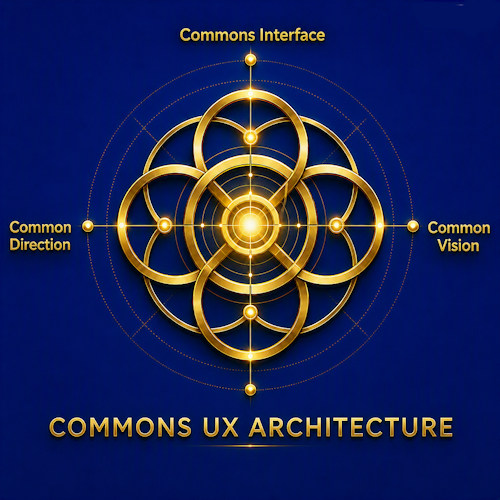
- Commons Interaction Models lead to Commons Networks as this is part of shared spaces.
- Commons Interface Containers lead to UI container structure.
- Commons Workflow expression is based on the Commons Workflow Engine to manage movements. Interfacing logic are part of the use of more specific workflow engines in the Initiative (RICAD or RAPTA).
- Commons Foundational Layers are belief aligned and grounded through interpretive and system oriented concepts.
- Common Narrative is responsive to users and organizational input, but it does align with the content provided by There and Back.
Experienced
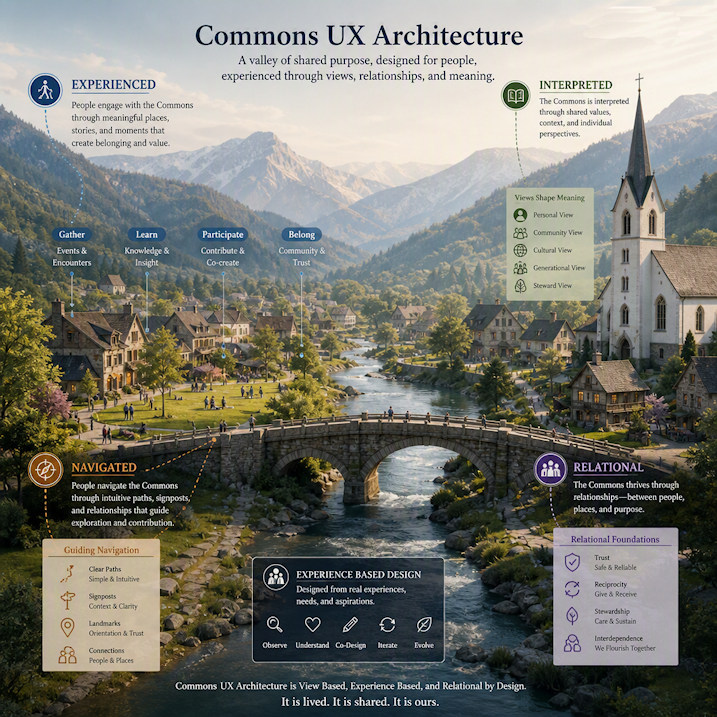
The Commons Experience is where people engage the Initiative through meaningful places, shared stories, and memorable moments that create belonging and shared value. In the Commons, people Gather through events and encounters that bring them together, Learn by gaining knowledge and insight that deepen understanding, Participate by contributing and co‑creating alongside others, and Belong through community, trust, and shared movement. It is a unified environment where people feel connected, supported, and part of something meaningful.
Interpreted
The Commons is interpreted through shared vision, shared context, and each person’s unique perspective — yet its Source remains consistent and the same for everyone. People understand the Commons through different views that shape meaning: a Personal View shaped by individual experience, a Community View shaped by shared relationships, a Cultural View shaped by traditions and values, a Generational View shaped by time and lived history, and a Steward View shaped by responsibility and care. Together, these views allow people to interpret the Commons in ways that feel personal and meaningful while still remaining anchored to a unified, consistent Source.
Navigated
The Commons is interpreted through shared vision, shared context, and each person’s unique perspective — yet its Source remains consistent and the same for everyone. People understand the Commons through different views that shape meaning: a Personal View shaped by individual experience, a Community View shaped by shared relationships, a Cultural View shaped by traditions and values, a Generational View shaped by time and lived history, and a Steward View shaped by responsibility and care. Together, these views allow people to interpret the Commons in ways that feel personal and meaningful while still remaining anchored to a unified, consistent Source.
Relational
The Commons thrives through relationships — between people, places, shared purpose, and our identity with the Lord. It is a relational environment built on Trust that feels safe and reliable, Reciprocity where people give and receive, Stewardship that cares for and sustains what is shared, and Interdependence where we flourish together rather than alone. Through these relationships, the Commons becomes a place of belonging, shared movement, and meaningful connection.
Commons Constructs
Commons Constructs are the Initiative’s shared structural constructs that provide stability, organization, relational mapping, and movement pathways for meaning, missions, content, and customer identity within Commons Architecture. They function as the Initiative’s structural backbone, enabling interpretive meaning to be transformed into system‑ready and market‑ready forms. Commons Constructs include relational networks, container‑based objects, workflow structures, foundational layers, business modeling components, relational customer constructs, and narrative/content structures. Together, they form the structural domain through which the Initiative’s worldview is operationalized, ensuring that all missions, products, and systems share a coherent architectural foundation.
Commons Construct Families
- Commons Universal – stable and consistent Commons constructs.
- Commons Networks — relational connectivity constructs that define how missions, customers, educators, and sponsored endeavors connect and interact.
- Commons Containers — stabilization constructs that hold meaning, content, missions, and narratives in structured form.
- Commons Workflows — movement constructs that route stabilized content into system execution, market delivery, or learning progression.
- Commons Foundational Layers — base structural layers (identity, relational, content, mission, narrative) that ensure shared architectural grounding.
- Commons Business Modeling Components — operational interpretation constructs that express business logic within the Initiative’s worldview.
- Commons Customer Relational Concepts — relational customer constructs that define identity, progression, narrative arcs, and alignment.
- Commons Content & Narrative Structures — meaning constructs that stabilize interpretive content, mission stories, and narrative identity.